January 16, 2012

CraftTexas 2012 Juror Jade Walker

CraftTexas 2012 is just around the corner! The call for artists will close on March 15, and the exhibition will run from September 29 - December 30, 2012. All of us at HCCC are looking forward to this, our seventh in a series of juried exhibitions showcasing the best in Texas-made contemporary craft. We are especially excited to have Jade Walker, an Austin-based artist and Director of the Visual Arts Center and the Creative Research Laboratory at the University of Texas at Austin, as one of our three jurors.

Walker is an active participant in the Texas visual arts community and, along with her day job as the director of the Visual Arts Center in the department of Art and Art History at the UT Austin, she has her own rigorous studio practice. On January 20th, an exhibition of her work, titled Contact, will open at Lawndale Art Center, our awesome next-door neighbor. The exhibition features an array of characters--some fictional and some real--permeated by physical breakdown and includes several sculptures and sculpture-based installations that are inspired by the physical repercussions of trauma on the human body.

Jade Walker,  Figures # 6.
Fabric, hat rack, mixed media
59” X 40” X 60" 2009
.
Photo courtesy the artist.

Jade Walker,  Figures # 6 (rear view).
Fabric, hat rack, mixed media
59” X 40” X 60" 2009
.
Photo courtesy the artist.

On October 5, 2011, the LVL3 exhibition space in Chicago had a post on their blog naming Jade Walker their “Artist of the Week,” and it included a short interview with the artist. When asked how to explain her work to a stranger, Jade responded, “My practice is a mixture between an exploration of materials (fabric, rubber, found objects, crusty old paints, tool-dip and whatever else I can get my hands on) and my desire to reproduce the human body.  I am interested in the mechanics of gender, both physically and symbolically, and that interest patinas the work as well.”

Walker’s exhibition at Lawndale could not be on display at a better time, as it will be an incredibly enjoyable opportunity to acquaint ourselves with her as a person and as an artist. CraftTexas 2010 is most definitely one of my favorite exhibitions that have been on display since I became part of the HCCC family in early 2010, and one of the reasons is the incredible variety of work that is submitted. Work in every craft medium, as well as both functional and non-functional work, is selected. I am thrilled to see what craft artists around Texas are currently making, and we hope that Walker enjoys participating in the jury process just as much as we enjoy putting the exhibition together.

Jade Walker, Trophy Room (detail 1).
Vacu-form panels, plastic, leather, found objects.
Site-Specific installation: 12’ X 11’ X 8’
Domy Books 2009. Photo courtesy the artist.
Jade Walker, Trophy Room (detail 2).
Vacu-form panels, plastic, leather, found objects.
Site-Specific installation: 12’ X 11’ X 8’
Domy Books 2009. Photo courtesy the artist.

The CraftTexas series began in 2002 and is one of the most exceptional and significant exhibitions in the Texas craft community. And, for HCCC, it is an event deeply rooted in the core mission of our organization. It serves as a starting place for the general public to appreciate the depth and breadth of craft being made in our own communities and across the state.

--Ashely Powell, Curatorial Assistant

To learn more about how to apply to CraftTexas 2012, click here.

If you would like to read more about Jade Walker and view more photos of her work, check out her website: http://jadewalker.org/

Click here to read the Lawndale press release that includes info on her exhibition.

January 3, 2012

Thoughts on SPUN

Needlepoint artist and Society for the Prevention of Unfinished Needlepoints (SPUN) founder, Mary Smull, came to HCCC for two events in early December. Smull is one of the artists featured in HCCC’s current exhibition, Beyond Useful & Beautiful: Rethinking Domestic Craft. Curator Anna Walker shares her thoughts on her work and the events.

I’m guilty of procrastination. There, I said it. I think it is something that everyone struggles with to some degree. I definitely remember it as a common excuse for many of my friends in school. What I find interesting about procrastination is the different ways and various projects that are unique to the procrastinator.

For instance, I’m known for beginning a project, getting it most of the way complete and then leaving the ending undone. This is true of the simplest tasks, such as mailing a birthday gift to a friend. I buy the gift, wrap it, and then it sits for weeks--sometimes months--in my office awaiting a short trip to the post office.

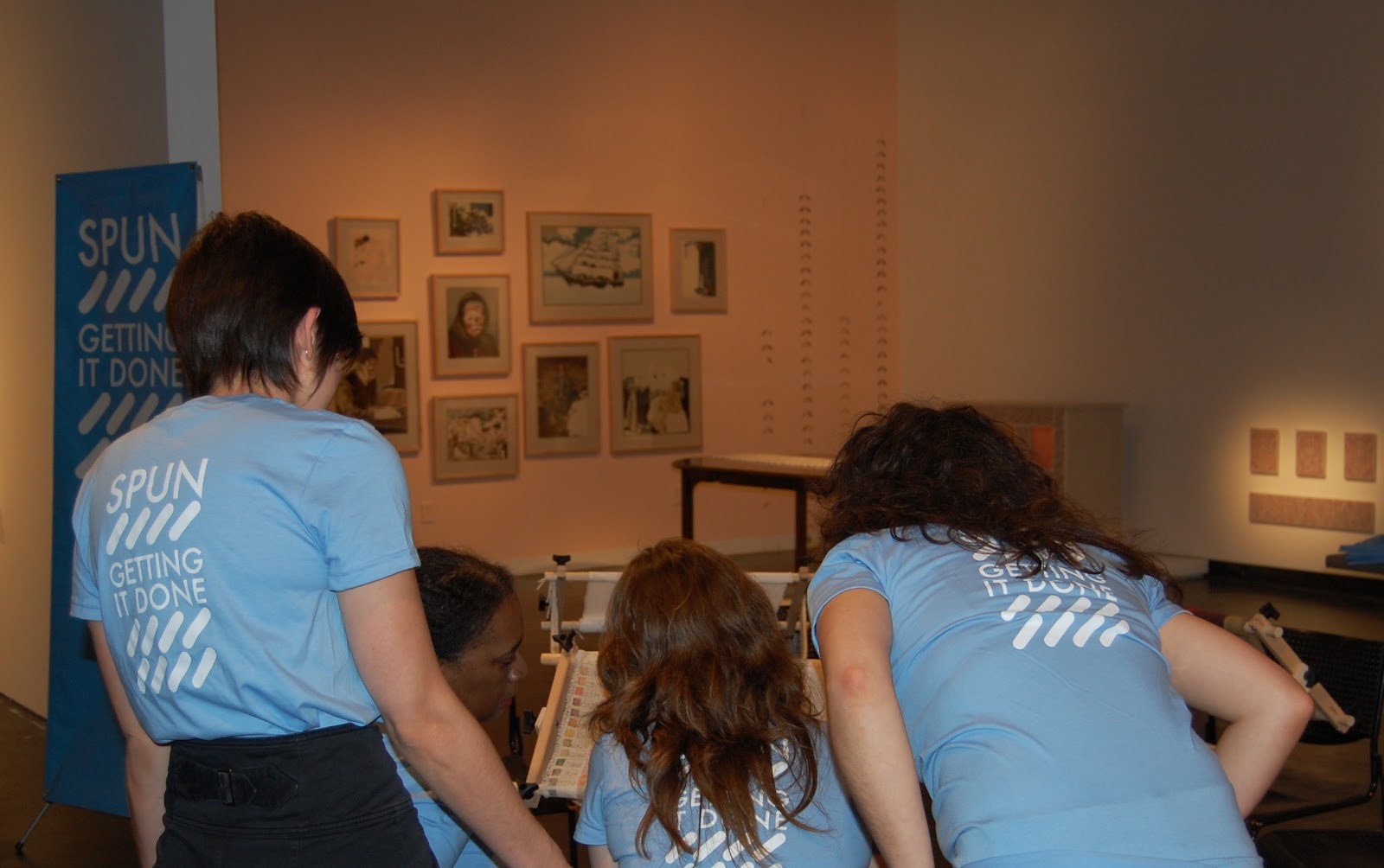
Through my personal experiences of “unfinished labor,” I am able to better appreciate the motivations behind Mary Smull’s Unfinished Needlepoint series.  Smull purchases unfinished needlepoints and completes them using only white thread, visually calling attention to that which was left undone, but also recognizing the labor invested by an anonymous hand. At the beginning of December, Smull brought her “Society for the Prevention of Unfinished Needlepoint” (SPUN) to our large gallery. A bright blue banner signaled the event, and representatives in matching blue t-shirts were there to assist visitors in completing stitches for the cause. (Click here to see the event photos.)

At Friday’s group therapy session, Finish Fetish, with artist Mary Smull.


SPUN representatives who helped “get it done.


Each visitor brought stories about their own unfinished projects, and we even had a visitor bring her own unfinished needlepoint in hopes that she would be inspired to complete it after talking with the artist. We talked extensively about the feelings associated with incompletion, guilt, avoidance, curiosity, even apathy. Looking back on the conversations, one area we did not spend as much time talking about were the reasons or thoughts on why works were left unfinished. Was it out of boredom with the project, competing external demands, or pure forgetfulness? 

I have to be honest--I even procrastinated on writing this post and on the previous assignment from Curatorial Assistant, Ashley Powell, which you can read about here.  What caused me to not even begin these projects? I would like to think it is because I had competing external demands, and that is partly true. However, for me, I recognize a fear of whether the finished project lives up to my initial expectations and standards. During Friday night’s discussion, Finish Fetish, we talked specifically about writing projects. How some of us never feel resolved about writing, and I agreed--writing can always be changed; it seems to constantly be under revision, editing, and perfecting. Perhaps, this is why I feared beginning the post, as I knew I might not reach the “finish.”

Above is an HCCC volunteer/SPUN representative assisting a
visitor at one of the unfinished needlepoint stations.


The counterpoint to SPUN’s blue t-shirts:  a group of ladies from “Oktoberfest,”
clad in pink t-shirts commemorating 27 years of gathering together.


You can follow Mary Smull’s “Society for the Prevention of Unfinished Needlepoint” on her website http://www.unfinishedneedlepoint.org. Her work is part of the current exhibition, Beyond Useful & Beautiful: Rethinking Domestic Craft at HCCC through Sunday, January 8, 2012.

-- Anna Walker, Curator

December 7, 2011

AIR Interviews: Leslie Shershow

This week, we share the second in a series of interviews with our current artists-in-residence (AIRs). Leslie Shershow is a metalsmith and jeweler from the small town of Belfast, Maine. After graduating from the Massachusetts College of Art with a BFA in metals, she stayed in the Boston area to further develop her jewelry at her studio in Somerville, MA, exhibiting her work in various group shows around the country. Prior to joining HCCC as an artist-in-residence, she taught metalsmithing to children and adults in various art centers and colleges in the Boston area and managed the metalshop at the School of the Museum of Fine Arts  for several years. She has been with HCCC since August and will be here through March, 2012. 


Diamond Rings by Leslie Shershow (plastic). Photo courtesy the artist.


Leslie Shershow. Diamond Ring, 2011.
Copper, brass, silver, auto paint. Photo courtesy the artist.

Tell us a little bit about your work.

Right now I'm inspired by wonky home improvements and functional crafts. I find much beauty in the way a novice craftsman might fix his home--I'm interested in the evolution of a domestic structure due to regular maintenance. I tend to work the same way--by starting with an object and scrounging for the part that will turn it into a functional piece of jewelry. The theme is pretty nostalgic for me--I grew up in Maine, so I use fishing and nautical imagery, along with funny home-maintenance things my dad used to do.
 
How did you get your start making jewelry?
I had first learned a little metalsmithing in high school crafts class and hated it. I melted my first project!  Later, in college, when it was time to choose my major, I was really impressed by the work that came out of the metals department, so metals is what I chose.

Where do your ideas come from? 
Everything, really. I guess my work comes out of interests that keep surfacing over and over again.

Leslie Shershow's necklace from the Home Improvement Series. Photo courtesy the artist.

Leslie Shershow's bracelet from the Home Improvement Series. Photo courtesy the artist.

What artist or designer do you admire, and why?
Iris Bodemer is one of my favorite jewelers (among many). I admire her because, in a lecture, she told us she took out a bank loan in the form of a gold block and proceeded to slice it into jewelry. That is very admirable to me.

In your bio, it says that you’ve taught metalsmithing to both children and adults. What do you enjoy most about teaching? What is it like teaching metalsmithing to children?
I really enjoy the challenge. Metalsmithing embodies so many different techniques, and many times, there are multiple ways to do something. I mostly taught small classes, so I had to work with each student individually to see what methods work best. Teaching children can be really difficult.  Metalsmithing is a tedious and time consuming practice, and there isn't much instant satisfaction. It's hard for kids to sit down and sand for hours, especially when they're wound up from a day at school and candy they got from 7-11.
 
What are you doing when you’re not creating?

I like hanging out with the other lovely AIRs and HCCC staff, visiting museums, and going for runs. Lately, my boyfriend and I have been working on a large stained-glass terrarium to prevent our cats from eating our plants. 


 Metalsmith and jeweler, Leslie Shershow. Photo courtesy the artist.


Describe yourself in five words.

I like to make things.

Being a Northerner, is there anything you find humorous or strange about Houston? I think it's funny that a lot of people in Houston's public places are either really dressed up or in their gym clothes. I come from a place of in-betweeners.

December 1, 2011

Needlepoint & Group Therapy with Mary Smull

Needlepoint artist and Society for the Prevention of Unfinished Needlepoints (SPUN) founder, Mary Smull, will be at HCCC for two events this weekend. Smull is one of the artists featured in HCCC’s current exhibition, Beyond Useful & Beautiful: Rethinking Domestic Craft and will be hosting two community events this weekend in the large Gallery at HCCC.


Mary Smull and participant at a recent SPUN event.
Mary Smull, Old Woman, 2008. Found unfinished needlepoint completed by
artist using only white yarn. 19 ½” x 23”. Photos courtesy the artist.


Smull’s work and SPUN deal with completing an object of labor--something that was abandoned and unfinished, despite the arduous effort put into the project. She is creating a sense of absolution for this occurrence that most everyone has experienced in one way or another. With our anticipation for these upcoming events, we thought it would be amusing to share some of the works that have been left unfinished by our staff members and artists-in-residence.

I sent out an email requesting a photograph of an unfinished work, a brief description, and why it was left incomplete. Fittingly, I received zero responses. This is most likely due to the inherent guilt people experience when time is invested in a project that has been left incomplete indefinitely and their reluctance to be an example. Humorously, because of this, I was now left with an incomplete project, being unable to actualize this blog post in the way I had intended.

I am hoping that the event on Friday evening will give me more insight into the realm of incompletion and all of the intense emotions that come with this territory. So, if you find yourself filled with anxiety or guilt about projects that have been abandoned around your house, then please join us for a conversation with Mary Smull for Group Therapy – Finish Fetish, Friday, December 2, from 6:00 – 7:00 PM.

If you are unable to join on Friday, Mary Smull will also be present on Saturday, December 3, from 1:00 - 4:30 PM, to host a SPUN session in our large gallery. SPUN is a community needlepoint project, founded by Smull in 2009 to “eliminate the worldwide phenomenon of unfinished needlepoint,” and has been rescuing incomplete works through performances across the country. You are invited to participate by completing stitches in unfinished needlepoint projects. Needlepointers of all abilities are welcome! Once complete, these works will be archived as part of SPUN’s collection. To learn more, visit the SPUN website here: http://www.unfinishedneedlepoint.org/

This is a great opportunity to release a little residual guilt or anxiety you may have and also help support SPUN’s mission, to prevent any needlepoint project from going unfinished. We hope you will join us for these two exciting and engaging events!

--Ashley Powell, HCCC Curatorial Assistant

November 27, 2011

How to Diagnose SOFA Fatigue

This week, HCCC Curator, Anna Walker, and Curatorial Fellow, Susie J. Silbert, share their thoughts on their recent trip to SOFA Chicago and the inevitable “SOFA Fatigue” that follows.  This phenomenon occurs after spending several days looking at hundreds of objects and talking with numerous individuals at SOFA, the Sculpture Objects and Functional Art fair on Navy Pier. The annual event takes place the first weekend of November and is the longest running art fair in Chicago (18 years). This year, the fair featured over 60 galleries with work from around the world. After several days of air kisses, handshakes, conversations and close-looking at objects, our curatorial duo returned to Houston enlightened but fatigued.
 
SOFA Chicago 2011. Photo courtesy SOFA Chicago.

SOFA Chicago 2011. Photo courtesy SOFA Chicago.


What Are the Signs of SOFA Fatigue?

Glazed Expression
With so many galleries and a section of five featured partner exhibits, there is a lot of art to go through. SOFA is a serious event, and many of the galleries make the most of their small 10’ x 10’ space. For example, Ornamentum featured the work of three jewelry artists:  Eunmi Chun, Caroline Gore, and Laura Prieto-Velasco. While these artists were highlighted with work displayed prominently on the walls, one could spend hours investigating the many drawers of works by other Ornamentum artists.

While we walked through the aisles, the “Solo at SOFA” booths provided a nice pause and rest for our eyes between the many spaces that were filled with work. These were spaces to feature the work by a single artist, and the booth featuring Devin Burgess did not disappoint. His carefully formed works were elegantly displayed in front of stripes of contrasting colors. With a similar attention to space and the careful selection of works, Heller Gallery chose works that filled the walls without overwhelming the area.  

Eunmi Chun,  Gorilla (Brooch), 2010.
Human hair, gold leaf, small intestine of cow, seeds, silver.
13 x 14 x 10 cm

Laura Prieto-Velasco. Charm (Ring), 2011.
Iron wire, latex paint, twist ties, gold plated silver. 3 x 2.2 x 1.8”.
Photo courtesy Ornamentum, Hudson NY.

Devin Burgess, Traces.
Blown glass, wheel cut surface
s. 23x16x12 inches.

Shoulder Strain
Shoulder strain is a common sign that your colleague has attended SOFA Chicago. Each day at the event presents a new opportunity to not only view work but talk with individuals, exchange business cards and, in the case of a few friends, acquire catalogues. The gentlemen at Thalen & Thalen had a beautiful catalogue available for sale alongside the delicate silver works. Each of these paper items was added to the familiar blue tote bag carried by all that includes the large, “official” SOFA catalogue.

Besides gallery areas, SOFA includes a resource area for nonprofit organizations to set up tables and promote memberships and publications. Among these tables, we met with many of our colleagues from fellow nonprofits, including the venerable Namita Wiggers, curator from the Museum of Contemporary Craft, and one of the jurors for the NCECA 2013 Biennial we are hosting at HCCC. Along with Namita, ceramicist Cristina Cordova will be a juror for NCECA 2013. Cordova shows with Ann Nathan Gallery and had a wonderful collaboration on display with Pablo Soto. Speaking of jurors, we also met with Jean McLaughlin, Executive Director of Penland School of Crafts, and one of the jurors for the upcoming CraftTexas 2012 exhibition at HCCC next fall. (The call for artists is open now through March 15, 2012, at https://www.callforentry.org/festivals_unique_info.php?ID=866&sortby=fair_name&apply=yes.)

How to Prevent SOFA Fatigue

Take Breaks
For us, taking a break meant finding a spot to sit and read one of the many publications available for free from the resource area at SOFA. These included American Craft Magazine, Ceramics Monthly, Glass Art Quarterly and Metalsmith Magazine. While we would have loved to have a seat on the sumptuous work by Vivian Beer at Wexler Gallery, we knew better and instead sought out an available bench.  

Take Snacks
Take actual snacks—a granola bar or an apple will do. Without snacks, one might begin to consider the possibility of eating from the decadent collage of frozen-in-time glassware created by Beth Lipman at Heller Gallery. We are excited to see what this amazing glass artist creates for an upcoming exhibit, The Tool at Hand, curated by Ethan Lasser of the Chipstone Foundation and opening at the Milwaukee Art Museum in a few weeks. In this exhibit, 14 artists were challenged to make a work using only one tool. The show will then travel to HCCC in the summer of 2013.

Beth Lipman, Whatnot I, 2010
Glass, glue, wood, paint.
84 x 42 x 30
Photo courtesy of Eva Heyd


Start Early
SOFA opens to the public at 11 a.m. However, if you have a VIP pass, you can get in at 10 a.m., and it’s necessary to go early if you want to see any work. We enjoyed marveling at work by Mark Peiser at Wexler Gallery that caught the light and presented a luminescence, drawing us in from far away. The jewelry exhibition of work by current and recent Cranbrook graduates, along with the Geography exhibition by Art Jewelry Forum, were also not to be missed. Walking through and identifying the work in the Cranbrook booth was an artistic experience in itself, thanks to the finely drawn map by Amy Weiks.

Starting early not only applies to the fair, but also to the networking that happens when hundreds of professionals in one field descend upon a city. We were happy to connect with neighbor Paula Owen, President of the Southwest School of Art, and learn about an upcoming exhibit featuring the work of Sonya Clark.

With these helpful tips and links, you’ll be ready to make the most of your next trip to SOFA and avoid the glazed eyes, sore shoulders, and zombie-like state of SOFA Fatigue!

--Anna Walker & Susie Silbert


November 8, 2011

Heidi Gerstacker Trunk Show – Coming Soon!

This week, Asher Gallery Manager, Suzanne Sippel, shares her thoughts on Houston metalsmith and jeweler, Heidi Gerstacker.

I have worked in the Asher Gallery at Houston Center for Contemporary Craft a little over four years. When I first started here, my mind was boggled by how many jewelers I represented, along with the sheer breadth of aesthetics and techniques. Having spent some time with fine jewelry in my former life, it was fun to start looking at fine-craft jewelry and seeing each piece as part of a larger oeuvre and not necessarily as client-driven work. There’s a great feeling when artists explain their techniques and passions. This was something I really enjoyed as I got to know Heidi Gerstacker.

Heidi has been represented by the Asher Gallery since November 2002 and has also been an active part of HCCC since its inception. She is active in the arts community in Houston and is part of its bloodlines.  Having attended jewelry classes at Bellaire High School and earning her MFA from the University of Houston, Heidi is an integral part of Houston’s metalsmithing tradition.  As we got to know each other, I was struck by how rare this is.  We may have many transplants and late-bloomers, particularly in fine craft, but there are few born-and-bred Houston career artists.

Working primarily in sterling silver, Heidi has created a consistent body of work over the years. Upon hearing marquise, most people think of diamonds or bad romance novels, but those in the know think of Heidi’s work. This shape forms the basis of her production jewelry. The crisp clean edges of the marquise bring out the strength of the precious metals and the precision of the maker’s hand. I believe this is what accounts for the timeless look that her pieces hold. They would and will feel modern, regardless of the era. But this is not the only part of Heidi’s aesthetic. She looks for the balance between having production pieces and defining one-off studio work. This is a difficult line for many artists to walk—creating works that can support their careers, while still producing the art that drove them into their fields initially.

Heidi Gerstacker, Marquise Pendant, sterling silver, moonstone, 2010.
Photo by the artist.

Leaf Brooch, sterling silver, moonstones, 2011. Photo by the artist.

It is this balance that you will find at Heidi Gerstacker’s Trunk Show at the Asher Holiday Soiree on November 17th.  You’ll find both stunning original pieces and the classic jewelry that has made Heidi a household name on the Houston jewelry scene. This is a special event for the Asher, as it is our first trunk show with Heidi in many years. It’s also rare to find so much of Heidi’s work at one time, so do not miss this opportunity! 

We’ve scheduled this event to fall on the first evening of the Houston Museum District’s Member Sale. With a current membership (at HCCC or any of the museums in the District), you’ll receive a 20% discount off your purchases (some restrictions may apply). We have made it as easy as possible to add to your collection of Heidi Gerstacker jewelry or to cross names off your holiday gift list. Now it is up to you to visit us!  Heidi’s trunk show will take place Thursday, November 17, 5:30 – 8:00 PM, and Saturday, November 19, 11:00 AM – 4:00 PM. Please come early for the best selection—once we’re out, we’re out!

--Suzanne Sippel, Asher Gallery Manager

October 25, 2011

AIR Interviews: Celia Butler

This week, we are posting the first in a series of interviews with our newest artists-in-residence. Celia Butler, from Carbondale, IL, is a mixed-media artist who holds a MFA from Cranbrook Academy of Art and a BFA from the Kansas City Art Institute. She has been with HCCC since August and will be here through the end of November. Be sure to come in and check out her studio before she leaves! To learn more about HCCC’s Artist-in-Residence Program, click here.

Celia Butler. Sugar Gazing, 2011. C print. Photo courtesy of the artist.

What kind of work do you make? 
I make work about fantasy and the over-idealized female, which I see as a strange combination of adolescence, sexuality, and perfection. The images I create are of a youthful and innocent female wearing a sugar bow some place on her body. Currently, I'm working on a life-sized porcelain doll that I will photograph similarly to my other photographic work. I'm also working on some heavily adorned, adult-sized baby bibs for the doll to wear. And, yes, I realize this sounds weird.


What is sugar pulling? Can you explain the process and how it became part of your work? Sugar pulling is a process in which you literally pull a hot sugar mixture until it becomes glossy and ribbon-like. Most people are familiar with ribbon candy, which is made with the sugar-pulling method.

I had previously been making work about adornment but decided that, instead of using bows made from real ribbon, I would use ones made from ribbon candy. Making the bows from sugar facilitates a critique on the contemporary idealized female because it implies an oversaturation of sweetness, innocence, and fragility. Candy's oral nature also suggests sexuality.

Celia Butler. Photo by Erin Sweeny and Brittany Nelson.

Are there any artists or designers who you are inspired by?
I think that artists who have successfully managed to make their studio practice their full-time job are pretty inspiring.

Where do you see yourself in 10 years?
Still making art.

What is your favorite thing about Houston?
Favorites are hard—and I've only been here for two months—but Houston's art scene seems to be busy and well supported.

Can you tell us something we’d be surprised to know about you?
My cell phone is broken and displaying everything upside down and backwards. If I haven't responded to your text, it's because I'm still trying to figure out what it says.

Who would play you in the movie of your life?
I'm assuming I'll be dead before that ever happens, so the casting director can just choose for me.