Showing posts with label Craft. Show all posts

March 10, 2012

Hurry up and Apply! CraftTexas 2012 Call for Artists Closes March 15th!


The
CraftTexas 2012 call for artists will soon be coming to an end. All of us at HCCC encourage every one of you procrastinators out there to hurry up and submit your applications before March 15th.


The CraftTexas series began in 2002 and is one of the most significant exhibitions in the Texas craft community. For HCCC, it is an event deeply rooted in the core mission of our organization, and it serves as a starting place for the general public to appreciate the depth and breadth of craft being made in our own communities and across the state. To me, the excitement comes in seeing the incredible variety of work being created across Texas. Every craft medium is represented, and the show includes both functional and non-functional work. The historic traditions and legacy of craft can be seen along with works that exemplify contemporary conceptual craft.

When I was thinking about writing this blog post, I began to wonder about the artists who participated in CraftTexas 2010 and where their careers have taken them. So, I sent an email to a few of the artists who participated two years ago, asking them for an update and a photo or two of new work. Although my request was a little last minute, I received three responses! Catherine Winkler Rayround, Kira Kalondy and Rebekah Frank sent me brief statements summarizing their current artistic endeavors and accomplishments. Keep reading below to learn more about these artists, and, if you’re an artist, we hope you’ll apply for Craft Texas 2012!

Catherine Winkler Rayroud
, Award of Merit winner for CraftTexas 2010, practices the art of paper cutting. In an email response to me, she wrote:

“Winning the merit award at CraftTexas 2010 was very important for me and led to some other wonderful opportunities. The same year, I won a juror’s award at CraftForms 2010, taking place at the Contemporary Craft Center in Wayne, PA, which was followed by another merit award at the 25th International Juried Show taking place at the Visual Arts Center in Summit, NJ. These two shows had jurors coming from the Smithsonian Institution in Washington, D.C., and the Guggenheim Museum in New York. The interesting thing with my paper cuttings is that I seem to constantly be able to cross the fine line between craft and contemporary art, and I feel very privileged to have found a medium that enables me to express my feelings, but also allows me to be a mirror of what is happening in our world today.”

“I also have a passion for the history of paper cuttings, and so I have been invited to give lectures and talks about this intricate art, which crosses borders and is practiced in many parts of the world. Last year, a museum in Germany asked me to organize a juried exhibition for the Guild of American Papercutters, and this show should start in June of this year if all goes well. Last year again, June Woest, from Urban Artists (www.junewoest.com), asked me if I would like to make a billboard, which would be exhibited along Bellaire Boulevard during the summer of 2011. The billboard was called ‘Enjoying the Rat Race???’ and was a wonderful experience and a completely new field for me.  Recently, I was invited to have three of my paper cuttings in the show, The Art of Seduction, taking place at the Rouse Company Foundation Gallery at the Howard Community College in Maryland, and curated by Gail Brown, who was one of the jurors of CraftTexas 2010. So lots of good things have happened to me, and it is very humbling to be able to do what I love most--paper cutting--and be able to get some recognition for it. I also started ‘cutting’ a book about women, and we will see where this new journey takes me.”

To read more about Catherine, visit http://www.catherinewinkler.com/Catherinewinkler/Home.html


Catherine Rayroud. Mama Rebel Biker.  26" x 18.5". Photo by C. Winkler Rayroud.

Catherine Rayroud. Billboard: “Enjoying the Rat Race??? Photo by C. Winkler Rayroud.

Kira Kalondy, is a ceramic artist and metalsmith, who responded:

“After 2010, when I was selected to be included in Craft Texas 2010, I was also selected for the juried show, Texas National 2010, and was awarded an honorable mention by juror Judy Pfaff. Also, I was part of the 5th Annual Intercollegiate Metals Exhibition held by Arizona State University in Tempe, AZ, and was awarded fourth place in the sculpture category. Besides this, I had a solo show called New Ceramics at Mary Hardin Baylor University in Belton, TX.”

“In 2011, I participated in some group shows, to name a couple: Sculpting Space at Goldesberry Gallery, in Houston, TX; Emerging Artists in Texas at College of the Mainland in Texas City, TX; and I also taught a two-day ceramic workshop at College of the Mainland.”

“Right now I am about to finish a Museum Studies Certificate from Stephen F. Austin State University (SFASU) in Nacogdoches, TX, and I work as the Event Coordinator for the SFASU Art Galleries (The Cole Art Center and the Griffith Gallery). This month of March, I have a solo show called Fusion at Lone Star College – Montgomery County in Conroe, Texas. The show runs from March 5-30, with a closing reception on the 29th.”

Be sure to check out her webpage at www.kirakalondy.com.


Kira Kalondy, Génesis. Ceramic, 9” x 22.5” x 12.5”, 2012. Photo by Christopher Talbot.
Kira Kalondy, Amanecer. Ceramic, 15” x 22” x 18”, 2012. Photo by Christopher Talbot.
Kira Kalondy, Lapislázuli. Ceramic, 10” x 22” x 23”, 2012. Photo by Christopher Talbot.

Rebekah Frank, a jeweler and metalsmith from Wimberly, TX, shared the following:

“I am currently at the Cranbrook Academy of Art, graduating in May with an MFA in Metalsmithing. I am working on a body of work, Catenate Collection, that will be shown at the Cranbrook Museum as part of the Degree Show exhibition. I will have work in the traveling exhibition, Mirror, Mirror, which will be shown at Espace Solidor in Cagnes-sur-Mer, France, and Velvet da Vinci in San Francisco, California.”

You can find more of Rebekah’s work on her website: http://rebekahfrank.com/home.html

Rebekah Frank. Catenate Collection, Various Necklaces, 2012.
Steel, 18 karat gold or silver solder. Photo Credit: Rebekah Frank

--Ashley Powell, HCCC Curatorial Assistant


January 31, 2012

Coming Soon--Bridge 11: Lia Cook

I am pleased to report that after a relatively smooth installation process this week (there are always some bumps along the way), the curatorial team at HCCC has finished installing Bridge 11: Lia Cook. When I went home for the day yesterday, there were only two pieces left that needed to be hung, and I came in this morning to find that Anna Walker, Curator, and Susie Silbert, Curatorial Fellow, had finished the installation. The exhibition is exquisite. I have been looking forward to it since the proposal was brought to the exhibitions committee meeting last year, and I am especially delighted that this show and HCCC will be a part of FotoFest 2012.


Above, clockwise from top left: Susie Silbert (HCCC Curatorial Fellow) up on the genie
lift during the installation of Bridge 11: Lia Cook. Partial view of Bridge 11: Lia Cook at
Houston Center for Contemporary Craft. Ashley Powell (HCCC Curatorial Assistant) and
Anna Walker (HCCC Curator) on the genie lift while installing Bridge 11: Lia Cook
at Houston Center for Contemporary Craft. Photos by Ashley Powell.

Lia Cook has been on the forefront of the textile-arts and craft communities for decades due to her visual innovations, as well as her technical mastery. Bridge 11 includes large-scale weavings of photographs created on an electronic Jacquard loom. The information present in each photograph has been translated into a computerized code for the loom to read. This is similar to the way a computer is able to break down a digital photograph into pixels, or tiny portions of information that construct the image when combined. The weavings present the viewer with traditional aspects of weaving, such as texture and pattern, as well as the intrinsic qualities of photographs, including time and memories. Cook’s work also investigates human vision, representation, and basic human emotional reactions.

Bridge 11 was organized by the Society for Contemporary Craft (SCC) in Pittsburgh, PA, and Cook’s work is part of the 11th biennial Bridge Exhibition Series. The series was first presented in 1988 to establish and heighten the public’s awareness of the powerful work being produced by contemporary artists.  SCC has presented solo exhibitions by 28 artists working in a broad range of craft media, including clay, metal, fiber, wood and glass.

As Anna, Susie, and I unpacked the work and ascended in the genie lift to hang the weavings on the walls and from the ceilings, I started thinking about the Bridge Series and began to wonder how it started, the way in which artists were selected, and why the title was chosen. I decided to contact the exhibitions department at SCC to learn more. Kate Lydon, the Director of Exhibitions, kindly took the time to speak with me earlier this week.


Above images: Susie Silbert and Anna Walker in the large gallery installing Bridge 11:
Lia Cook
  Houston Center for Contemporary Craft. Photos by Ashley Powell.

Some of the first topics we spoke about were the series’ origin, the mission, and the significance of the title. Lydon has been at SCC for quite a while and informed me that, in the early years of this series, the dialogue about the divide between craft and fine art was growing immensely. Since then, she believes this conversation has started to fall by the wayside and isn’t as significant. With this in mind, the series had a goal to bridge the gap and blur the lines between craft and fine art, to show high-quality work by mid-career artists working in the traditional craft media. When I asked her whether the original mission still stands today, she responded by explaining that the divide is not highlighted as much, because the conversation has subsided; however, this series and the title provide an opportunity to reference it historically.

The idea of showing mid-career artists goes back to the title of the series and the theme of a bridge. The idea was to explore the gap between early and late-career craft artists. So, not only is the bridge used to lessen the gap between craft and fine art, but also generations of makers.

Lydon informed me about SCC’s selection process and how they search for artists not only creating high-quality works but also creating with a concept behind the work. The processes the artists are using are taken into consideration. Since the exhibition is comprised of three solo-artist shows, exhibiting work of different scale and media is important. The diversity and contrast helps to highlight the uniqueness of each artist’s work.

We are very excited to be a participating venue for Bridge 11: Lia Cook, and we hope you will join us for the opening reception this Friday, February 3, 5:30 – 8:00 PM.

Bridge 11: Lia Cook will be on display February 4 – May 13, 2012, in the large gallery, along with Transference: Andy Paiko & Ethan Rose in the small gallery.  Alyssa Salomon–The Handmade Print will be on view February 4 – April 8, 2012, in the Artist Hall.

--Ashley Powell,
HCCC Curatorial Assistant

January 16, 2012

CraftTexas 2012 Juror Jade Walker

CraftTexas 2012 is just around the corner! The call for artists will close on March 15, and the exhibition will run from September 29 - December 30, 2012. All of us at HCCC are looking forward to this, our seventh in a series of juried exhibitions showcasing the best in Texas-made contemporary craft. We are especially excited to have Jade Walker, an Austin-based artist and Director of the Visual Arts Center and the Creative Research Laboratory at the University of Texas at Austin, as one of our three jurors.

Walker is an active participant in the Texas visual arts community and, along with her day job as the director of the Visual Arts Center in the department of Art and Art History at the UT Austin, she has her own rigorous studio practice. On January 20th, an exhibition of her work, titled Contact, will open at Lawndale Art Center, our awesome next-door neighbor. The exhibition features an array of characters--some fictional and some real--permeated by physical breakdown and includes several sculptures and sculpture-based installations that are inspired by the physical repercussions of trauma on the human body.

Jade Walker,  Figures # 6.
Fabric, hat rack, mixed media
59” X 40” X 60" 2009
.
Photo courtesy the artist.

Jade Walker,  Figures # 6 (rear view).
Fabric, hat rack, mixed media
59” X 40” X 60" 2009
.
Photo courtesy the artist.

On October 5, 2011, the LVL3 exhibition space in Chicago had a post on their blog naming Jade Walker their “Artist of the Week,” and it included a short interview with the artist. When asked how to explain her work to a stranger, Jade responded, “My practice is a mixture between an exploration of materials (fabric, rubber, found objects, crusty old paints, tool-dip and whatever else I can get my hands on) and my desire to reproduce the human body.  I am interested in the mechanics of gender, both physically and symbolically, and that interest patinas the work as well.”

Walker’s exhibition at Lawndale could not be on display at a better time, as it will be an incredibly enjoyable opportunity to acquaint ourselves with her as a person and as an artist. CraftTexas 2010 is most definitely one of my favorite exhibitions that have been on display since I became part of the HCCC family in early 2010, and one of the reasons is the incredible variety of work that is submitted. Work in every craft medium, as well as both functional and non-functional work, is selected. I am thrilled to see what craft artists around Texas are currently making, and we hope that Walker enjoys participating in the jury process just as much as we enjoy putting the exhibition together.

Jade Walker, Trophy Room (detail 1).
Vacu-form panels, plastic, leather, found objects.
Site-Specific installation: 12’ X 11’ X 8’
Domy Books 2009. Photo courtesy the artist.
Jade Walker, Trophy Room (detail 2).
Vacu-form panels, plastic, leather, found objects.
Site-Specific installation: 12’ X 11’ X 8’
Domy Books 2009. Photo courtesy the artist.

The CraftTexas series began in 2002 and is one of the most exceptional and significant exhibitions in the Texas craft community. And, for HCCC, it is an event deeply rooted in the core mission of our organization. It serves as a starting place for the general public to appreciate the depth and breadth of craft being made in our own communities and across the state.

--Ashely Powell, Curatorial Assistant

To learn more about how to apply to CraftTexas 2012, click here.

If you would like to read more about Jade Walker and view more photos of her work, check out her website: http://jadewalker.org/

Click here to read the Lawndale press release that includes info on her exhibition.

December 7, 2011

AIR Interviews: Leslie Shershow

This week, we share the second in a series of interviews with our current artists-in-residence (AIRs). Leslie Shershow is a metalsmith and jeweler from the small town of Belfast, Maine. After graduating from the Massachusetts College of Art with a BFA in metals, she stayed in the Boston area to further develop her jewelry at her studio in Somerville, MA, exhibiting her work in various group shows around the country. Prior to joining HCCC as an artist-in-residence, she taught metalsmithing to children and adults in various art centers and colleges in the Boston area and managed the metalshop at the School of the Museum of Fine Arts  for several years. She has been with HCCC since August and will be here through March, 2012. 


Diamond Rings by Leslie Shershow (plastic). Photo courtesy the artist.


Leslie Shershow. Diamond Ring, 2011.
Copper, brass, silver, auto paint. Photo courtesy the artist.

Tell us a little bit about your work.

Right now I'm inspired by wonky home improvements and functional crafts. I find much beauty in the way a novice craftsman might fix his home--I'm interested in the evolution of a domestic structure due to regular maintenance. I tend to work the same way--by starting with an object and scrounging for the part that will turn it into a functional piece of jewelry. The theme is pretty nostalgic for me--I grew up in Maine, so I use fishing and nautical imagery, along with funny home-maintenance things my dad used to do.
 
How did you get your start making jewelry?
I had first learned a little metalsmithing in high school crafts class and hated it. I melted my first project!  Later, in college, when it was time to choose my major, I was really impressed by the work that came out of the metals department, so metals is what I chose.

Where do your ideas come from? 
Everything, really. I guess my work comes out of interests that keep surfacing over and over again.

Leslie Shershow's necklace from the Home Improvement Series. Photo courtesy the artist.

Leslie Shershow's bracelet from the Home Improvement Series. Photo courtesy the artist.

What artist or designer do you admire, and why?
Iris Bodemer is one of my favorite jewelers (among many). I admire her because, in a lecture, she told us she took out a bank loan in the form of a gold block and proceeded to slice it into jewelry. That is very admirable to me.

In your bio, it says that you’ve taught metalsmithing to both children and adults. What do you enjoy most about teaching? What is it like teaching metalsmithing to children?
I really enjoy the challenge. Metalsmithing embodies so many different techniques, and many times, there are multiple ways to do something. I mostly taught small classes, so I had to work with each student individually to see what methods work best. Teaching children can be really difficult.  Metalsmithing is a tedious and time consuming practice, and there isn't much instant satisfaction. It's hard for kids to sit down and sand for hours, especially when they're wound up from a day at school and candy they got from 7-11.
 
What are you doing when you’re not creating?

I like hanging out with the other lovely AIRs and HCCC staff, visiting museums, and going for runs. Lately, my boyfriend and I have been working on a large stained-glass terrarium to prevent our cats from eating our plants. 


 Metalsmith and jeweler, Leslie Shershow. Photo courtesy the artist.


Describe yourself in five words.

I like to make things.

Being a Northerner, is there anything you find humorous or strange about Houston? I think it's funny that a lot of people in Houston's public places are either really dressed up or in their gym clothes. I come from a place of in-betweeners.

October 25, 2011

AIR Interviews: Celia Butler

This week, we are posting the first in a series of interviews with our newest artists-in-residence. Celia Butler, from Carbondale, IL, is a mixed-media artist who holds a MFA from Cranbrook Academy of Art and a BFA from the Kansas City Art Institute. She has been with HCCC since August and will be here through the end of November. Be sure to come in and check out her studio before she leaves! To learn more about HCCC’s Artist-in-Residence Program, click here.

Celia Butler. Sugar Gazing, 2011. C print. Photo courtesy of the artist.

What kind of work do you make? 
I make work about fantasy and the over-idealized female, which I see as a strange combination of adolescence, sexuality, and perfection. The images I create are of a youthful and innocent female wearing a sugar bow some place on her body. Currently, I'm working on a life-sized porcelain doll that I will photograph similarly to my other photographic work. I'm also working on some heavily adorned, adult-sized baby bibs for the doll to wear. And, yes, I realize this sounds weird.


What is sugar pulling? Can you explain the process and how it became part of your work? Sugar pulling is a process in which you literally pull a hot sugar mixture until it becomes glossy and ribbon-like. Most people are familiar with ribbon candy, which is made with the sugar-pulling method.

I had previously been making work about adornment but decided that, instead of using bows made from real ribbon, I would use ones made from ribbon candy. Making the bows from sugar facilitates a critique on the contemporary idealized female because it implies an oversaturation of sweetness, innocence, and fragility. Candy's oral nature also suggests sexuality.

Celia Butler. Photo by Erin Sweeny and Brittany Nelson.

Are there any artists or designers who you are inspired by?
I think that artists who have successfully managed to make their studio practice their full-time job are pretty inspiring.

Where do you see yourself in 10 years?
Still making art.

What is your favorite thing about Houston?
Favorites are hard—and I've only been here for two months—but Houston's art scene seems to be busy and well supported.

Can you tell us something we’d be surprised to know about you?
My cell phone is broken and displaying everything upside down and backwards. If I haven't responded to your text, it's because I'm still trying to figure out what it says.

Who would play you in the movie of your life?
I'm assuming I'll be dead before that ever happens, so the casting director can just choose for me.


October 19, 2011

Jennifer Ling Datchuk Video

Artist Jennifer Ling Datchuk writes about her experience working with Mark and Angela Walley to create a short documentary that addresses the core issues surrounding her work and her artistic process. Four of Datchuk’s pieces are currently on display in the in-house-curated exhibition, Beyond Useful and Beautiful: Rethinking Domestic Craft. Datchuk has enthusiastically shared this video with us, and with all of you, as well as providing us with a little insight into its making and content.


Ceramic Artist Jennifer Ling Datchuk invites us into her home for an intimate look into her artistic process and the personal experiences that have shaped her perspective of race and identity. Datchuk’s family history unfolds as she creates a piece entitled “worry”. Also, featured in the film is her loveable dog Scooter, who joins her every step of the way. Learn more about the artist at http://www.JenniferLingDatchuk.com.


It’s never easy watching yourself on video.  It’s one thing to create works of art, display them in a public gallery and let them speak for themselves.  I’ve always been comfortable talking about the core issues surrounding my work and my distant relationship with my parents but, initially, I wasn’t prepared to say it on camera and have it live forever on the Internet. 
The Walleys were amazing to work with and made the whole situation extremely comfortable.  Angela asked great questions, and Mark captured every perfect moment, especially those involving my dog, Scooter.  What was created was a short, four-minute biography video about my life and artistic process.  It tells my personal experiences of race, identity and family and why I choose to create the work that I do.  These topics can sometime feel too heavy and difficult to talk about, and I am glad that there are elements of humor in the video. 

In the video, I construct one of my unfired handkerchief pieces.  I use found and handmade molds to slip cast and create the wall plaque and chicken-foot pieces.  After the building process, the piece is bisque fired and then a clear glaze is applied.  The piece is also adorned with a traditional Chinese blue and white transfer.  Once the firings are completed, I hang the piece on the wall and start to determine how the handkerchiefs are placed.

I dip the handkerchiefs in a mixture of porcelain slip (liquid clay) and wallpaper glue.  I work quickly, while the slip-glue mixture is still liquid, to dip and then tie and knot the fabric pieces together.  Once complete, it will take a few days for the piece to dry and form a slightly hard shell.  I do not fire the pieces because this shell will age and yellow over time and convey a timelessness that a static and fragile fired piece could not. 

This video has allowed me to share my story, and it has been worth it every step of the way.  The feedback I have received has been wonderful, and I still find lots of people who share my story.  Scooter can tell you, we are more alike than we are different. 

--Jennifer Ling Datchuk

To find out more about the Walleys and their films, check out their website.

September 26, 2011

Soundforge: In Process (Updates # 4 & #5)

This fall, HCCC will premier a work two years in the making. In the fall of 2009, while still in residence, metalsmith Gabriel Craig began collaborating with Houston-based music composer, Michael Remson. Their project, Soundforge, will be an interactive, multimedia installation that explores forging metal as both a means of fabrication and an act of percussion. Gabriel Craig has graciously agreed to give us regular updates from his studio on the fabrication of the project.

The feet were cut from 1/8 in. steel sheet in a pyramidal pattern, tact welded together,
seam welded on the inside, then welded cosmetically on the outside corners
before being ground. They were then welded to the armature at right.

Update #4


In my artistic process, there are several galvanizing moments in each project that energize me and allow me to proceed in what is an otherwise difficult and trying vocation. The first of these moments is always the conception of the project, that initial spark of an idea. “Hey, what if I …” In Soundforge, I am well past that now. The second moment usually occurs well into the fabrication of a work and is the realization that, yes, the initial idea can, and is currently, being realized. Call it a moment of actualization.

Welding the first foot onto the armature newel.

I had that actualizing moment recently, as I completed fabricating the feet of the armatures for Soundforge. After some fitting and situating, I welded them on and, behold, Soundforge can stand! Having no previous large-scale steel fabrication experience, this was trying. With silver, I could just force the thing into place; however, plate steel has a much stronger will. The fact that, structurally, the work functions is boon to confidence and more generally a milestone in the creation of the project. I can see it coming together, and I know, finally, that it will work.

It is these energizing moments – where vision meets reality, where the hand approximates the imagination – that make being an artist worth the doldrums. Yes, I know that is a bit cliché, but it is true. I had one of those moments, and I am sharing it. Soundforge stands!

A shot of the first free-standing armature just inside my studio,
adjacent to my lush mid-western garden.

Update #5

Since my last update, I have welded three-inch vertical supports onto the armature cross
braces. This has increased the overall sturdiness of the armatures and
also created a logical space for decoration.

The past few weeks have been among my favorite on the project. A lot of the tedious and trying fabrication is done, and now I am at the anvil all day – every day. I am making small forgings, listening to music and books on tape, losing myself for hours as I sweat in the near-hundred-degree heat of my shop. It’s not Texas-hot to be sure, but 90 degrees with 90-percent humidity, plus a forge running, is not exactly mild.

After forging 36 three-inch ornamental finials, I worked on
their layout within the 3 x 12 inch frames on the armature.

My interest and love of moving metal is at least in part why I got into this project, and I have been able to watch myself improve in strength, stamina and toughness everyday. Manual labor, in any form, can be a meditation, but aside from enjoying the work, I am intermittently aware of the battle between the work and my body. Hard labor has a decidedly penal connotation in my mind, but I think there can be no other way to describe forging such thick material, by hand, for such durations. Don’t mistake this for a complaint, because I do not loathe the work, but rather it has caused me to consider labor as more than simply a romantic extension of my idyllic principals.

I have also been meaning for a while to sneak in a shot on my studio assistant,John Eagan.
A recent graduate of the metals program at Wayne State University in Detroit, John has been a
huge help working with me two days a week since June. John has helped me with a lot of the heavy forging,
wielding a sledge, since I don’t have a power hammer. He is also meticulous, as any respectable
metalsmith should be. Here, he is drilling holes in a newel for the cable that will suspend the keys.

There is a cost to smithing – beyond the material and the tools, that is. Smithing is bought in scale burns, calluses and stinging hands in the morning. The cost of 36 finials is that of aching joints, tired feet and singed arm hairs. But for each hammer blow, I am more tenacious, sinewy and graceful in my work. Forging might cost more physically than most other forms of manual labor, but there is something compelling about the hammer, which makes it perhaps the most revered tool throughout human history. It draws people in. Most people think wielding a hammer is about power – the sledge in the carnival game where one tries to ring a bell. Yes, power is the hammer’s attraction; it is a tool that reflects our aspirations of strength. It is also, perhaps, the simplest of all hand tools. However, this is deceiving because anyone worth their salt with a hammer knows that strength does not matter if you miss your target. To watch someone experienced with a hammer is nearly always a moment of wonder. Everyone can understand the simplicity of the hammer--you swing it, and you move something. In the hands of an expert, we can see skill personified; we recognize an unpretentious tool performing extraordinary work. The hammer is the ultimate vernacular tool, and it is the efficient use of it, as an action or performance, which allows us to see skill manifest.

Here are a few of the ornaments welded onto the armature. It really does
give a visual weight to the work. Once the newel finials and keys are in place, the armatures
will have a much more substantial feel. Compositionally, I feel like I am doing a line drawing in iron.

When Michael Remson and I set out on this odyssey, I think that we wanted to capture forging as a performative action that both embodies and demonstrates skill. In itself, this is a complete thought. However, no matter the efficiency or inexperience of the person wielding the hammer, striking will always make a sound. Hammering is a multivalent action in this way. I think we are just a few short weeks away from demonstrating this and also seeing how far that idea can be pushed. On one level, hammering aspires to extreme skill, but on another level, it participates in a much different conversation. But that is for another post…  

--Gabriel Craig

September 1, 2011

Staff Favorites from "Crafting Live(s): 10 Years of Artists in Residence."

With the closing of Crafting Live(s): 10 Years of Artists-in-Residence rapidly approaching, we asked the staff of HCCC to share what their favorite pieces are and why. The exhibition contains works by 36 artists who have participated in the Artist-in-Residence Program here at HCCC during the past 10 years. If you’ve seen the show, please share your favorites in the comments below! If you haven’t, then hurry in, the show closes this Saturday, September 3!

Julie Farr, Executive Director, had a particularly difficult time picking just one favorite piece. Farr explains, “I think it’s because so many of these artists have become our colleagues and friends, and we’ve seen them in process and progressing during their residencies. When the exhibition first opened, I was excited to see how far everyone pushed themselves by making new, meaningful works. I love that both the residency experience and HCCC are a safe haven for exploration, growth and creativity in action.”

Communications Director, Mary Headrick, chose 6 Degrees by Cathy Cunningham-Little. “I think it’s an absolutely stunning installation. The suspended rain-drop-like forms, the amount of light and reflection they create, and the fact that the artist created them from silvered glass is fascinating.  These are complemented by the metal pieces below, which cast wide and interesting shadows."

Cathy Cunningham-Little, 6 Degrees
Etched, stainless-steel ladles and silvered
blown glass. Variable dimensions.

Curator, Anna Walker, chose the imaginary children by Bethany Rusen for two reasons. “One, I’m drawn to works that have a haunting presence and anthropomorphic gesture. But also, I grew to love this piece during installation. Constructed of a nylon fabric stuffed with polyfill, then dipped in clay slip, the forms are awkward, pliable and yet also brittle when handled. On the wall I have a similar reaction to the work as when I held it, and I enjoy that those two interactions complement each other.”

Education Director, Miriam Mendoza’s favorite is Friends by Ann Trask. This piece is made from used tea bags, reclaimed wood pieces, fimoclay, tea-stained muslin and wax. Miriam greatly appreciated the artist’s use of everyday objects, things many people would deem as trash, and re-contextualizing them into objects with meaning. These tea bags are not just trash, but a remnant of the experience of enjoying a cup of tea with a friend. The tea bags have become symbols of the artist’s many relationships and friendships. To Miriam, the piece conveys an important message of not taking for granted the objects and people present in our everyday lives. Miriam also finds the piece to be aesthetically pleasing.

Ann Trask, Friends. Used teabags, reclaimed
wood pieces, tea-stained muslin, wax. 73” x 50” x 4"

Jenny Lynn Weitz, Marketing and Web Assistant, chose Darryl Lauster’s Runners Up Presidential Plate Series. “I like the fact that Lauster is attempting to commemorate the losing candidates by depicting them on hand-cast porcelain transferware, and even though the stories behind each portrait involve a lot of important political, social and economic issues, I find the installation humorous and sad at the same time.”

Associate Director of Fundraising, Nyala Wright’s favorite is also Darryl Lauster’s Runner’s Up Presidential Plate Series. Nyala chose this as her favorite because the installation of plates is historically informative with an outstanding sense of humor.

Darry; Lauster, Runners-Up Presidential Plate Series. 28 individual
hand-cast porcelain transferware plates. 12” x 12” x 1" each

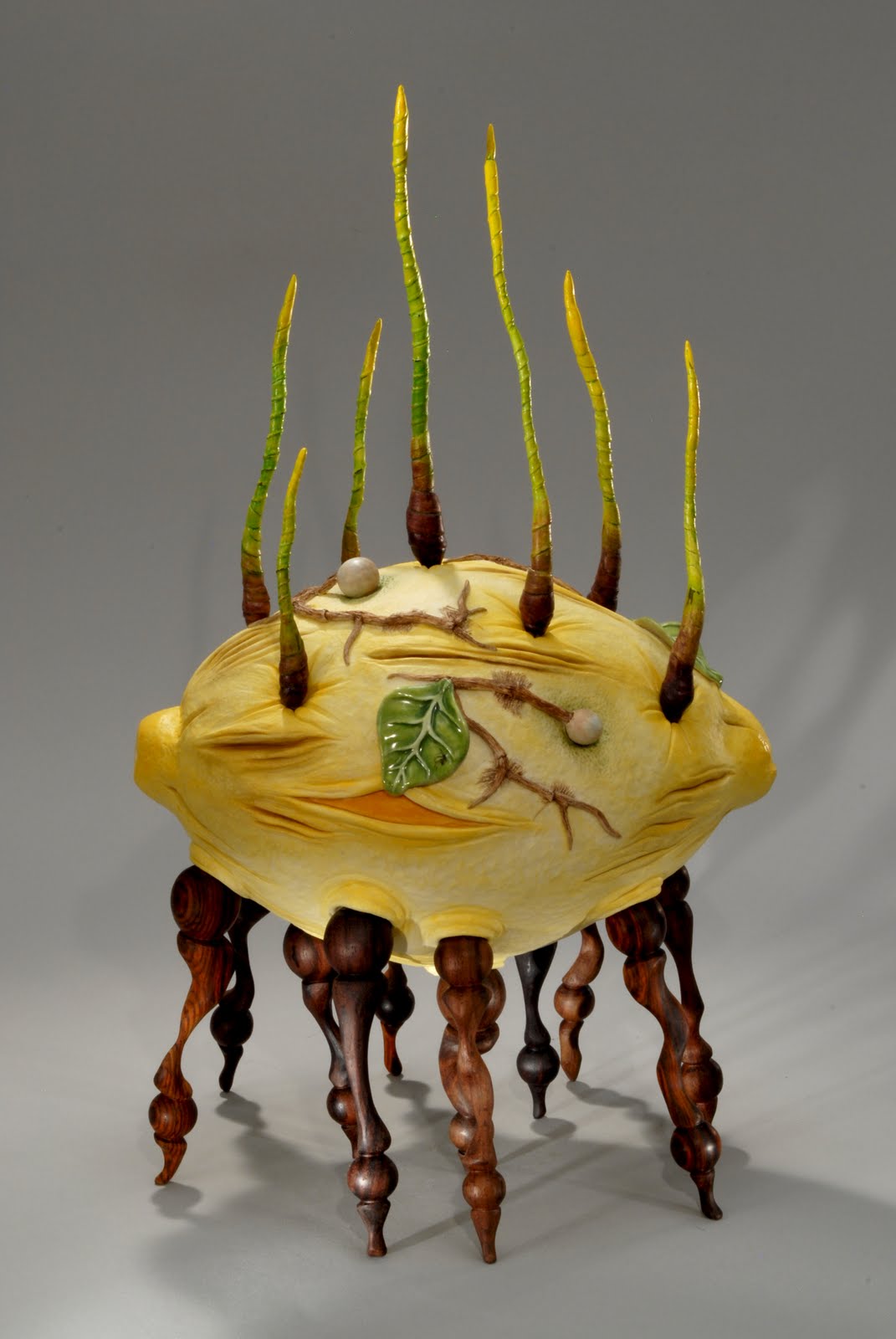
Two staff members also chose Jason Kishell’s Stilted Lemon Growth. Suzanne Sippel, Asher Gallery Retail Manager, wasn’t sure how to describe why, but said, “I like the monstrous lemon, and considering the dreadful things I put lemons through with my tea... well, this is their revenge!”

Curatorial Fellow, Susie Silbert, states, “With so many great pieces in the exhibit, it’s hard to choose just one favorite (well, for me just one favorite is always an issue). Today, I would choose Jason Kishell’s Stilted Lemon Growth. Its craftsmanship is amazing—Kishell’s commitment to his materials and ideas is evident in his close attention to detail in all aspects of the work’s execution, from the detailed veining of the roots on the lemon’s surface to the multi-axis lathe work on its many wooden legs. Stilted Lemon Growth looks like an emissary from a fully formed world inside Kishell’s imagination, leading me to wonder who the other inhabitants may be. The object has the playfulness of a fairytale, the high definition of a video game and enough surface information to keep me interested for quite some time.”

Jason Kishell, Stilted Lemon Growth.
Porcelain, polymer clay, wire,
Indian rosewood. 9” x 11” x 19”

Curatorial Assistant, Ashley Powell, chose Rough Neck by Edward McCartney. McCartney’s clever use of materials is what really struck her, the way he has re-contextualized motor oil through its usage in an object of adornment. Just as so many other valuable natural resources are used to make jewelry, oil has now been fashioned into charms or gems of “black gold,” reminding us of how much of a commodity it is to our contemporary society.

August 19, 2011

Crafting Live(s): Ten Years of Artists-in-Residence -- Spotlight on Fiber Artist, Greg Rubio

Guest Curator, Keelin Burrows, writes about past artist-in-residence Greg Rubio and his work in Crafting Live(s): Ten Years of Artists-in-Residence. The exhibition is on view at HCCC through September 3, 2011. Burrows is currently the Windgate Charitable Foundation Curatorial Fellow at The Museum of Fine Arts, Houston.

Greg Rubio, a Texas native, obtained his BFA from Texas A&M University in Corpus Christi in 1996 and his MFA from the University of Delaware in 1998. As an accomplished painter and draftsmen, he has made an impact on the Houston and international art scenes, earning a Fulbright scholarship to study in Mexico in 1999 and a Cultural Affairs Grant through the United States Embassy to study in Spain in 2005. His cross-relationships and interests in Latin, Hispanic, and American cultures have influenced his work, constantly driving him to re-examine his natural and constructed surroundings.

Rubio was a resident artist at HCCC from September 2007 to August 2008.  At that time, he was creating functional archery targets from old clothes and sheets, which he tore, cut, assembled and sewed into compositional arrangements. He enjoyed the process of destroying and mending recycled materials into something of beauty and personal significance.  Apple Barge Archery Target and Mayan Snake Square with Japanese Flowers Archery Target, both from 2006, are examples of his early fabric works. 


Greg Rubio. Apple Barge Archery Target. Photo by Christopher Zaleski.

Greg Rubio. Mayan Snake Square with Japanese Flowers Archery Target.
  Photo by Christopher Zaleski.


Drawing from his family heritage of archery and sewing, Rubio created compositional narratives through iconography, color fields, and stitching. Each target expresses a personal story or moment of self-inquiry.  Apple Barge portrays imagery and subject matter of the seaport along the Texas Gulf Coast, where the artist grew up and currently lives and teaches. Mayan Snake Square with Japanese Flowers represents cultural traditions and rituals learned through personal history and travels abroad via a more abstract composition.

For Crafting Live(s), Rubio built upon these past themes and narratives, creating Rope Dart.  Consisting of various knotted ropes and a railroad spike, the sculpture at first appears to be a vast departure from his earlier work.  However, upon closer examination, the process of cultural exploration through material and technique becomes apparent. Maritime life, a defining feature of coastal Texas, literally and figuratively ties together the community of Corpus Christi.  Rubio, having learned various knotting techniques from his father, who was a fisherman and a sailor, incorporates several knots into his work.  Some of these include a seizing bend knot in the main yellow coil; a blowline knot that secures the two ropes together; and a snelling knot, which holds the railroad spike in suspension.


Greg Rubio. Rope Dart. Photo by Jack Zilker.


During his residency at HCCC, Rubio attended the Chung Tai Chan Center, where he learned and practiced tenets of Zen Buddhism.  Although Rubio learned to make rope from a basket weaver during his residency, he chose to use found ropes from the local fishing community of Corpus Christi.  These objects are “attachments” that carry personal and cultural associations for the artist, referencing an industry that defined his upbringing and sustained his home town.  Additionally, the metal railroad spike, a remnant found along the tracks near his studio, also carries personal significance and associations with the evolving industrial landscape of his local community. The spike, referred to as dart, circles back to Rubio’s personal and family history with archery and sewing.


Corpus Christi Marina. Image courtesy Greg Rubio.

Kingsville rail road tracks. Image courtesy Greg Rubio.


Perhaps, most interesting is the way in which Rope Dart, and Rubio’s work in general, complicates categorical distinctions.  Knotting, when viewed in the context of manual labor and fishing, is often situated as a “folk” tradition in Western cultures.  However, when viewed through the ideological lens of other cultures, such as those in ancient China or Japan, where the distinction between art and craft did not exist, the practice and tradition of knotting is elevated to an art form.  From a Western perspective, knotting today might be viewed as a “studio craft,” due to an original emphasis on functional value and process.  Regardless of terminology, Rubio draws from this knotting tradition, weaving together personal and cultural meanings, and establishing artistic significance through material, technique, and concept.

August 12, 2011

What are the current AIRs up to?

This week, we stopped by the Artist-in-Residence studios to find out what they’re working on. Next time you visit us, make sure to stop by to meet the artists and learn about their current and upcoming projects! 


After a great feature in the Houston Chronicle last month and the jewelry she displayed at our Martini Madness! Kickoff Party at ROAK, metalsmith and mixed-media artist, Kristi Rae Wilson, has been very busy.  Recently, we caught her carefully soldering an armature for the piece pictured below.

Kristi Rae Wilson working in her studio at HCCC.


Kristi Rae Wilson soldering silver.


Part of Kristi Rae Wilson’s studio at HCCC.
The soldered armatures above are attached to the pink piece in the
middle.

Ceramic artists, Marcia Erickson and Jamie Diaz, have been with us for just a couple of months, but they have jumped on board quickly and are busy making martini glasses for our upcoming Martini Madness! 10th Birthday Bash on September 22! Marcia told us she has been implementing new patterns and colorful glazes into her work, and every time we walk by Jamie’s studio, she’s working on the wheel!


Ceramic artist Marcia Erickson 
in her studio at HCCC,
showing us 
her handmade martini glasses.
Look at the colors and textures!


Jamie Diaz in her studio at HCCC, working on the wheel…


Jamie Diaz making martini glasses for Martini Madness!
We’re looking forward to seeing the finished pieces!

We found metalsmith and jewelry designer, Lisa Wilson, working on one of her latest pieces outside, in the Craft Garden.

Lisa Wilson finishing up a commissioned 
piece made of copper.


Jessica Dupuis has been working on a new piece for this fall’s Artist Hall show, In Residence 2010, in which 2010 artists-in-residence will display new works.  Join us on September 30 for the opening reception, where you’ll see all of our new fall exhibitions, including Beyond Useful and Beautiful: Rethinking Domestic Craft and Soundforge.


Jessica Dupuis working on her latest piece.

To learn more about our current Artists-in-Residence and the AIR Program, click here. To find out more about our Martini Madness! 10th Birthday Bash, follow this link.

All photos courtesy of HCCC.