Showing posts with label Exhibitions at HCCC. Show all posts

April 22, 2012

A Tale of Two Cities through Ceramics

ACT I: Seattle

This year, the 46th Annual NCECA (NationalCouncil on Education for the Ceramic Arts) Conference was “On the Edge.” True to its theme, the conference was in Seattle, on the edge of the Pacific coast in what proved to be a wonderful, walkable and welcoming city.

I’ve been to many conferences, but had yet to visit NCECA. I had previously followed the 2010 Philadelphia conference through crafthaus’s emerging artist blog and, similarly, this year, both crafthaus and NCECA will have blogs updating soon here and here.

Rather than try and recap the entire event, I thought I’d hit some highlights that connect back to HCCC and Houston. Besides, NCECA will be in Houston in 2013, and it’s important to draw connections and let folks in on the dirty little secret:  Houston and its “walkable-museum-district”  is great, despite what people say about the traffic.

Image from the “Houston. It’s Worth It” campaign.
Sarah Lindley and Norwood Viviano’s Kohler Diptych, 2010, glazed China clay at
Push Play: The NCECA 2012 Invitational at Bellevue Arts Museum. Photo Courtesy of HCCC
  
SCENE I: Bellevue

One of my first stops at NCECA was the Bellevue Arts Museum (BAM) for the exhibition PushPlay: The NCECA 2012 Invitational. The exhibit features work by 35 different artists loosely organized around a theme of play that is not always full of “fun and games.” The first work I viewed immediately brought up thoughts of Houston. As the fourth largest city in the nation, Houston is home to more than 5,000 energy-related firms and touted by the City of Houston as the EnergyCapital of the world.  Created while they were artists-in-residence at the Kohler Company, Sarah Lindley and Norwood Viviano’s Kohler Diptych responds to early American industry, and the BAM label describes how “the artists combine industrial technologies such as rapid prototyping, slip casting, and factory production with play technologies such as staging and the miniature to reference notions of dependence, control and consequence.” (Footnote 1)

Besides the NCECA 2012: Invitational,  BAM had two other great exhibitions on the third floor. DirkStaschke: Falling Feels a Lot Like Flying featured the lavish ceramic work of Dirk Staschke, winner of the John and Joyce Price Award of Excellence at the BAM Biennial 2010: Clay Throwdown! In the same floor just around the corner, Nora Atkinson curated Making Mends, a group exhibit of artists who expand on the therapeutic benefits of art. (Nora wrote a guest blog post for us in the past on the traveling exhibit, Lisa Gralnick: The Gold Standard, which you can find here and here. 

Dirk Staschke’s Consuming Allegory, ceramic and mixed media, 2012

Cynthia Giachetti’s Centerpiece, porcelain, wood, found objects, 2007
from the exhibit Making Mends
SCENE II: Seattle

A great thing about the NCECA conference is the number of exhibitions throughout the city and surrounding area devoted to ceramics, including around 30 exhibitions at the Seattle Design Center. One of the exhibitions featured a new piece by Janice Jakielski titled Sweet Melancholia and the Case for Infinite Sadness.

I was excited to see Janice’s work in person, as she will be having a solo exhibition at HCCC in January of 2013 that will be up through the Houston NCECA conference that year. Through her mixed-media approach, incorporating wall decorations, textiles, and ceramics, Jakielski seeks to engage the viewer in new ways of seeing and sometimes disrupting our understanding. Here, the white ceramic flowers are overlaid with a colorful embroidery hoop.  Looking through the mesh, the colors overlap the white forms but, from the side, we see the illusion at play.

Janice Jakielski’s Sweet Melancholia and the Case for Infinite Sadness (detail)

Janice Jakielski’s Sweet Melancholia and the Case for Infinite Sadness

The conference itself took place at the Washington Convention Center and had a variety of lectures, panel discussions, and demonstrations. Former CraftTexas artist, Marianne McGrath, was a co-curator of the Projects Space described as having conceptual and material conversation, taking the artists “beyond the confines of their kiln.” This included a performance by The Brick Factory, a performance-art collective of artists:  Summer Zickefoose, Nicole Burisch, Tom Myers, and Erik Scollon. The four met last summer at Actions + Material, A Watershed Center for the Ceramic Arts residency, and a shared interest in ceramics and performance art prompted the creation of this group.


Marianne McGrath’s piece Mine, yours & ours, but mostly mine as installed at
HCCC in CraftTexas 2010, porcelain, string, Mylar, photo by Jack Zilker.

The Brick Factory re-stage of Jim Mechert’s 1972 performance, Changes, but with a musical
addition—hopefully, a video will come soon to their blog http://thebrickfactory.tumblr.com/

In thinking of performances and happenings, I allowed myself a night out in Seattle and attended SPROUT. SPROUT is a local grassroots event centered on a community dinner that funds emerging artists through a vote. In this case, there were six different artists and projects proposed throughout the evening, with the final vote being cast in support of Celeste Cooning’s cut-paper workshop, Cut It Out. It was inspirational to see community support of emerging artists and different projects, all of which can be viewed on their website, and this prompted me to begin thinking about how an event like this could take root in Houston.

SPROUT volunteers in preparation for the dinner, a photo from their website

A poster from the event as photographed by me.

Directly following my NCECA travels, I came back to Houston and quickly continued the ceramic adventure with a second act in Baton Rouge, Louisiana.

ACT II: Baton Rouge

This time, I picked up a traveler in Susie Silbert, Curatorial Fellow, for a road trip to LSU, their ceramics department, and to talk with their visiting artist, Clare Twomey. We were fortunate to have met studio potter and assistant professor at LSU, Andy Shaw, at the opening of MFAH’s ShiftingParadigms in Contemporary Ceramics: The Garth Clark and Mark Del VecchioCollection. In a follow up email, he invited Susie and me to visit while Clare was at LSU for an artist residency.

Clare is a British artist and currently a research fellow at the University of Westminster. She’s known for working in clay, often creating or staging large-scale installations that are site specific. At LSU, she was engaging with the entire ceramics department in making 1,000 bowls. She described how the project is exploring the reasons behind making through the act of making. For two weeks, the department will work on this one task and document the process through a blog, which you can find here.


Tumblers by Andy Shaw as pictured on the Elle Décor blog.

Clare Twomey’s recent project, Is It Madness. Is It Beauty, a work commissioned
for the Siobhan Davies Studios.

FINAL SCENE

After a full week of viewing ceramics from the West Coast to the banks of the Mississippi, I’m overwhelmed by the visuals that keep resurfacing in my head. It will be exciting for Houston to host NCECA next year, and I look forward to more visits to LSU, Baton Rouge, and the great state of Louisiana (though I guess I have to say not as great as Texas). I’ll leave you with two final images linking Baton Rouge to Seattle.


A walkway and ferry on the Mississippi

Yuichiro Komatsu’s  Schema No. I, 2, and 3, low fire white clay, glaze, decal, 2011,
as photographed in Seattle Design Center exhibit, To Wander Out of Place.

--Anna Walker, HCCC Curator

(Footnote 1) - Bellevue Arts Museum. Museum label for Sarah Lindley and Norwood Viviano. Kohler Diptych. Bellevue, 29 March 2012.

March 17, 2012

Alyssa Salomon in Town for Workshop & FotoFest

Curatorial Assistant, Ashley Powell, shares her thoughts and interview questions with artist Alyssa Salomon.

Above, from left to right: Alyssa Salomon, these wild ecstasies (for A. Siskin).
Cyanotype, waxed. 2010. Photo by Terry Brown. Alyssa Salomon, Tell Me again, the
World will be Beautiful.
  Van dyke, waxed. 2009. Photo by Terry Brown. Alyssa Salomon, Untitled.
Van dyke on handmade paper, metal, waxed. 2011. Photo by Alyssa C. Salomon.

Currently on display in the Artist Hall is the exhibition, Alyssa Salomon--The Handmade Print. Salomon’s works are stunning examples of contemporary photography that use 19th-century photographic processes as well as handmade surfaces. She uses Van Dyke printing, Cyanotype printing, and is a member of the international artist community of the Contemporary Daguerreotype.

Her work in the two series, Tell me again, The World Will Be Beautiful and Mind’s Eye, provides us with more than just a glimpse into the natural world. She hopes to evoke a sense of nostalgia, to “recall an abundance of sights seen, held dear, and linked by recollection -- scenes gathered through binoculars and focused eye, from shore and balcony, beyond the fence and within one’s garden.”

When I was unpacking these works and, as I pass by them every day, I am repeatedly struck by the artist’s representation of the often forgotten or overlooked pure and intrinsic beauty of nature, which is always surrounding us. These images are fleeting moments of the human experience. She demonstrates a unique way to view the trees, the birds on the telephone wires, the sea gulls circling overhead and our place within this natural world.

In the excitement surrounding having Alyssa in town this weekend to teach an alternative photographic processes workshop at the Museum of Printing History, I wanted to find out more about her work to share with our readers.

On your website, you said you’ve been taking photos since you received a camera on your eighth birthday, but when did you start experimenting with 19th-century photographic processes? What was it about these antique processes that enticed you to explore them further?

I had pretty much used the same silver-gelatin paper brand and just a couple film stocks for two decades until 2000, when in expanding a body of work that mined the visual language of vernacular photographs, I learned to make daguerreotypes, first in a Penland class with Jerry Spagnoli, and later as an apprentice to Robert Schlaer. The experience of seeing the world rendered in an unexpected photographic form and the compelling photographic objects that the process produced changed my studio practice.  19th-century and handmade photographic processes gave me brilliant tools to retell the world through photography.  And my successes with the complexities and subtleties of the daguerreotype process made me fearless.

Can you explain how you relate and compare your studio practice to the realm of contemporary craft?

I see my studio practice with handmade photographic processes as part of significant currents within contemporary craft and material studies, particularly the exploration of materials and intentionality around process. I use photographic printmaking the way a metalsmith might approach the fabrication of jewelry: everything is fair game as material and structure. My images are objects that result directly from their parts and methods. While process, for me, is important and necessary, it is not sufficient; process gives me tools for rendering for the viewer a sensory experience that embodies the physical delights of locating ourselves in the natural world. 

The capacities of light-sensitive compounds and the properties of paper provide voice to speak of the energy of the oceans, the blue of the sky, and the entrancement by birds. Ordinary and wondrous phenomena are my means and my subject.

Can you briefly explain to us your creative process, staring with the way in which you capture your photos?

My process is much like that of a birdwatcher in the field: disciplined by skill, attuned to sight, and gifted by chance.  But my purpose is to render the reality of the mind’s eye rather than the truth of the eye.  My images begin with a lens, but are realized through the properties of printing process.  Each unique picture is crafted with photographic chemistries, light, and hand work.  I mix my photographic solutions from basic compounds, brushing them on handmade and fine papers to produce light-sensitive surfaces on which negatives are exposed.  The final images, with velvety surfaces inherent to the van dyke and cyanotype methods and intensified with wax, are more like drawings than photographs, more like memories than documents.

In examining the roots of my infatuation with the natural world and with elemental photochemistry itself, I realized I owe much to an undergraduate education in the writings of British Romantic poets, and eighteenth- and nineteenth-century English and French social history. A number of my titles are drawn from William Wordsworth’s poem, Tintern Abbey, which lays out a rich detailing of landscape and the transcendence of recollection.  Other titles in this body of work come either from Charles Wright’s book of poems, A Short History of the Shadow, or from my imagination. 

For the viewer, I hope these artworks together recall an abundance of sights seen, held dear, and linked by recollection--scenes gathered through binoculars and focused eye, from shore and balcony, beyond the fence and within one’s garden.

What aspects of the world we live in have inspired you to create this work you think of as a call “to inactive action”?

Pervading the work is a celebration of beauty and its pursuit.  In our consumer culture of throw-away imagery, environmental anxieties, financial turmoil, and unsettling political discourse, the contemplation of untamed beauty is essential to living life richly amidst the manmade. This project invites the viewer to inactive action:  to sit, to see, to acknowledge the accumulation of sensory experience, and to reminisce. 

Why is using handmade paper significant to your work? How do you choose what papers to use, and where do they come from?

Beginning to work with handmade paper was a revelation, but in hindsight it seems so obvious.  The processes I use--and the iconic images I use to create them--are so basic that each component has a significant impact.  With these handmade photographic processes--cyanotype, van dyke, salted paper--one has the light-sensitive emulsion one mixes from a few simple compounds, the paper it goes on, the brush, the light, and the negative or other material used to shape the light as it strikes the light-sensitive paper.  Much like cooking with only a few ingredients, the character, flavor and quality of each has a major impact on the outcome.

Amazing paper is being made these days--I'm lucky to have used a lot of paper made by Helen Hiebert, leftovers from Dieu Donne', and a few sheets made by Anne Marie Kennedy.  The marble, Steve Pittelkow, gave me a couple of dozen sheets, which were the last of his archives of paper he had made and collected over the decades. I'll try anything--you never know until you experiment what a paper can do, what the attributes of the paper will bring to the final image--surface texture, color, sizing, fiber content.  A paper's reactions with the photochemistry all affect the crispness, tone, detail, and value range of the image.  Paper that is pigmented means the image doesn't have white but is whatever color the paper is (pink, green, orange) and whatever the photographic chemistry is (blue with cyanotype, brown with van dyke).  The fiber content and sizing impact hue of the chemistry. There is a wonderful heavyweight kozo stocked by the photochemical supply house, Bostick & Sullivan, that I've been using for crisp images recently.

What are you most looking forward to during your visit to Houston?

Working with the creative community that surrounds HCCC & the Museum of Printing History is a great opportunity.  As a landscape, Texas and Houston are very unlike where I live--an ancient cypress swamp in an agricultural county outside Richmond, which is a small, East Coast city distinguished by small-scale, late-19th- and early-20th-century architecture.  I'm looking forward to the visual rush and disorientation that happens in looking at and negotiating the unfamiliar.  And, of course, coming to Houston during Fotofest is a great opportunity--how wonderful to be part of the outpouring of photographers and photography enthusiasts amid a photography extravaganza.


"A couple of snapshots that I've taken by kayak of where I live.
We moved here five years ago after decades of urban life--with the intention
of making the amazing and wild part of daily life and vision." Alyssa Salomon.

The workshop, Master Alt Photo Workshop with Alyssa Salomon: "The ABCs of Alternative Photographic Processes" takes place Saturday, March 17, 10:00 AM – 4:00 PM at the Museum of Printing History. The workshop is sold out.  Participants will make cyanotype and salted-paper prints, two of the easiest, earliest and loveliest 19th-century photographic processes.

For more information about the artist, visit http://alyssasalomon.com/home.html


February 22, 2012

Transference and the Glass Armonica

We are incredibly lucky to be showing the multimedia exhibition, Transference, by glass artist Andy Paiko and experimental sound artist Ethan Rose, in the small gallery at HCCC.

Their piece is based on the idea of the singing wine glass—the amazing ability of glass vessels to produce sound when rubbed with a wet finger along their top edge. This phenomenon has fascinated people since at least the 16th century (and personally I’ve been fascinated by it since I discovered it for myself at a bar mitzvah at age 13), but it was never more popular than in the mid 1700s. At that time, Benjamin Franklin, the statesman and inventor, took it upon himself to make the singing wine glasses easier to play.

Benjamin Franklin’s glass armonica.
Source: pbs.org.

Using the same ingenuity and focus that brought the world electricity, bifocals and the urinary catheter, Franklin set about improving this curious instrument. First, he had glassblowers create 38 vessels of graduating sizes. Then, he nested them on a spindle that rotated by pressing peddles—much like those on a piano [image of armonica]. In fact, the whole instrument, which he called the glass armonica took the shape of a piano (an interesting side note on naming: Franklin said he named the instrument for the “musical country” of Italy because it seemed particularly well suited for “soft and plaintive” Italian music. Read it in his words here.

Players could sit in front of this instrument and place both hands on the rotating spindle of glasses before them. Whereas the horizontal layout of the singing wine glasses meant a player could only make two notes at a time, one with each hand, on the armonica, each finger could hit a separate note. The invention opened a world of possibilities and became an instant success.  Mozart and Beethoven composed for the instrument and several well-to-do families purchased armonicas for home use.

Thomas Bloch plays his glass harmonica made by Gerhard Finkenbeiner.
 
But the armonica’s fame was short lived. Just 20 years after its illustrious debut, there was widespread concern that the instrument’s ethereal notes had a serious negative effect on players’ moods, causing depression and neurological disorders. Though there were likely many reasons for this precipitous downfall, one of the most convincing (and certainly the most juicy) is that the armonica’s bad reputation came from its association with Franz Mesmer, the inventor of hypnotism and from whom we get the word “mesmerization.”

As legend has it, Mesmer would use the instrument to lull his patients (his work was considered more or less “medical”) into an entranced state where they could not be held responsible for their actions. This loss of decorum, so out of line with late-eighteenth-century social morays, caused the instrument to be seen as suspect.

Whether this was the main reason the armonica went out of fashion or not, within decades the instrument was hardly known and by the turn of the 20th century, it had all but disappeared, a lost footnote in the history books. That is, until Ethan and Andy unearthed it.

Ethan Rose and Andy Paiko were introduced by mutual friends while both were living in Portland, Oregon. Recognizing a shared interest in recovering and repurposing antiquated objects and technologies, Ethan and Andy worked to find a subject for a collaborative installation. On a camping trip, they visited the Spark Museum of Electrical Invention. It was there that they got the idea for this exhibition.

Using the armonica as their source, Ethan and Andy have created an exquisite installation showcasing the possibilities of the material—specifically glass vessels--to create sound. By removing the player from the installation (glass mechanisms, like record arms with fabric tips, meet the surface to create sound), the artists have placed the attention on the objects themselves; they have created a perfect environment for contemplating the properties of glass, the capabilities of material, the processes of creating and hearing sound, and the legacies of history.

Installation view of Transference: Andy Paiko & Ethan Rose
at Houston Center for Contermporary Craft
Photo by Kim Coffman

Installation view of Transference: Andy Paiko & Ethan Rose
at Houston Center for Contermporary Craft
Photo by Kim Coffman

But don’t take my word for it—hear Andy Paiko and Ethan Rose speak about the piece themselves in these incredible videos below. And come on in to see the show—it’s up until May 13, and it’s worth seeing multiple times.


-- Susie Silbert, HCCC Curatorial Fellow

January 31, 2012

Coming Soon--Bridge 11: Lia Cook

I am pleased to report that after a relatively smooth installation process this week (there are always some bumps along the way), the curatorial team at HCCC has finished installing Bridge 11: Lia Cook. When I went home for the day yesterday, there were only two pieces left that needed to be hung, and I came in this morning to find that Anna Walker, Curator, and Susie Silbert, Curatorial Fellow, had finished the installation. The exhibition is exquisite. I have been looking forward to it since the proposal was brought to the exhibitions committee meeting last year, and I am especially delighted that this show and HCCC will be a part of FotoFest 2012.


Above, clockwise from top left: Susie Silbert (HCCC Curatorial Fellow) up on the genie
lift during the installation of Bridge 11: Lia Cook. Partial view of Bridge 11: Lia Cook at
Houston Center for Contemporary Craft. Ashley Powell (HCCC Curatorial Assistant) and
Anna Walker (HCCC Curator) on the genie lift while installing Bridge 11: Lia Cook
at Houston Center for Contemporary Craft. Photos by Ashley Powell.

Lia Cook has been on the forefront of the textile-arts and craft communities for decades due to her visual innovations, as well as her technical mastery. Bridge 11 includes large-scale weavings of photographs created on an electronic Jacquard loom. The information present in each photograph has been translated into a computerized code for the loom to read. This is similar to the way a computer is able to break down a digital photograph into pixels, or tiny portions of information that construct the image when combined. The weavings present the viewer with traditional aspects of weaving, such as texture and pattern, as well as the intrinsic qualities of photographs, including time and memories. Cook’s work also investigates human vision, representation, and basic human emotional reactions.

Bridge 11 was organized by the Society for Contemporary Craft (SCC) in Pittsburgh, PA, and Cook’s work is part of the 11th biennial Bridge Exhibition Series. The series was first presented in 1988 to establish and heighten the public’s awareness of the powerful work being produced by contemporary artists.  SCC has presented solo exhibitions by 28 artists working in a broad range of craft media, including clay, metal, fiber, wood and glass.

As Anna, Susie, and I unpacked the work and ascended in the genie lift to hang the weavings on the walls and from the ceilings, I started thinking about the Bridge Series and began to wonder how it started, the way in which artists were selected, and why the title was chosen. I decided to contact the exhibitions department at SCC to learn more. Kate Lydon, the Director of Exhibitions, kindly took the time to speak with me earlier this week.


Above images: Susie Silbert and Anna Walker in the large gallery installing Bridge 11:
Lia Cook
  Houston Center for Contemporary Craft. Photos by Ashley Powell.

Some of the first topics we spoke about were the series’ origin, the mission, and the significance of the title. Lydon has been at SCC for quite a while and informed me that, in the early years of this series, the dialogue about the divide between craft and fine art was growing immensely. Since then, she believes this conversation has started to fall by the wayside and isn’t as significant. With this in mind, the series had a goal to bridge the gap and blur the lines between craft and fine art, to show high-quality work by mid-career artists working in the traditional craft media. When I asked her whether the original mission still stands today, she responded by explaining that the divide is not highlighted as much, because the conversation has subsided; however, this series and the title provide an opportunity to reference it historically.

The idea of showing mid-career artists goes back to the title of the series and the theme of a bridge. The idea was to explore the gap between early and late-career craft artists. So, not only is the bridge used to lessen the gap between craft and fine art, but also generations of makers.

Lydon informed me about SCC’s selection process and how they search for artists not only creating high-quality works but also creating with a concept behind the work. The processes the artists are using are taken into consideration. Since the exhibition is comprised of three solo-artist shows, exhibiting work of different scale and media is important. The diversity and contrast helps to highlight the uniqueness of each artist’s work.

We are very excited to be a participating venue for Bridge 11: Lia Cook, and we hope you will join us for the opening reception this Friday, February 3, 5:30 – 8:00 PM.

Bridge 11: Lia Cook will be on display February 4 – May 13, 2012, in the large gallery, along with Transference: Andy Paiko & Ethan Rose in the small gallery.  Alyssa Salomon–The Handmade Print will be on view February 4 – April 8, 2012, in the Artist Hall.

--Ashley Powell,
HCCC Curatorial Assistant

January 3, 2012

Thoughts on SPUN

Needlepoint artist and Society for the Prevention of Unfinished Needlepoints (SPUN) founder, Mary Smull, came to HCCC for two events in early December. Smull is one of the artists featured in HCCC’s current exhibition, Beyond Useful & Beautiful: Rethinking Domestic Craft. Curator Anna Walker shares her thoughts on her work and the events.

I’m guilty of procrastination. There, I said it. I think it is something that everyone struggles with to some degree. I definitely remember it as a common excuse for many of my friends in school. What I find interesting about procrastination is the different ways and various projects that are unique to the procrastinator.

For instance, I’m known for beginning a project, getting it most of the way complete and then leaving the ending undone. This is true of the simplest tasks, such as mailing a birthday gift to a friend. I buy the gift, wrap it, and then it sits for weeks--sometimes months--in my office awaiting a short trip to the post office.

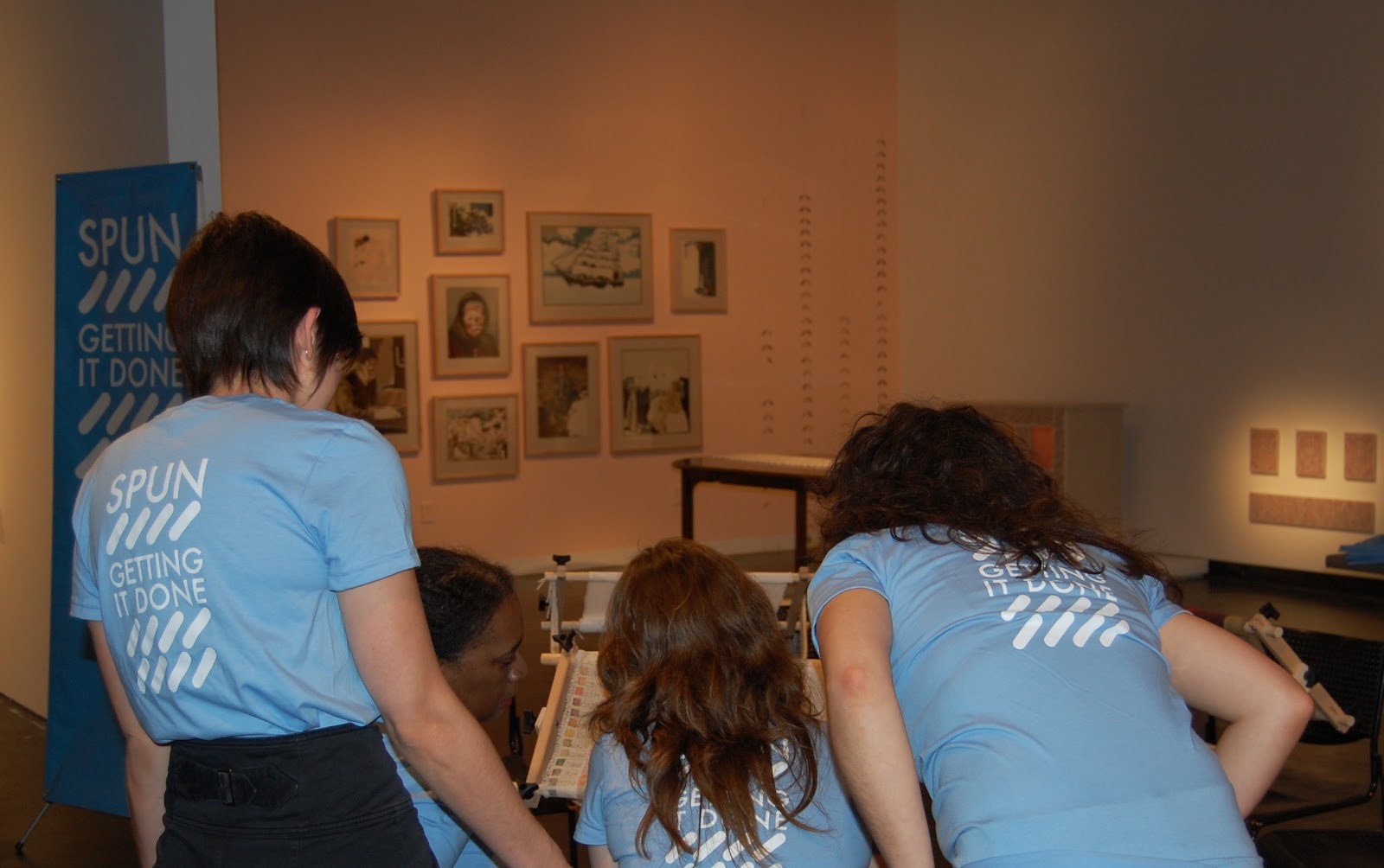
Through my personal experiences of “unfinished labor,” I am able to better appreciate the motivations behind Mary Smull’s Unfinished Needlepoint series.  Smull purchases unfinished needlepoints and completes them using only white thread, visually calling attention to that which was left undone, but also recognizing the labor invested by an anonymous hand. At the beginning of December, Smull brought her “Society for the Prevention of Unfinished Needlepoint” (SPUN) to our large gallery. A bright blue banner signaled the event, and representatives in matching blue t-shirts were there to assist visitors in completing stitches for the cause. (Click here to see the event photos.)

At Friday’s group therapy session, Finish Fetish, with artist Mary Smull.


SPUN representatives who helped “get it done.


Each visitor brought stories about their own unfinished projects, and we even had a visitor bring her own unfinished needlepoint in hopes that she would be inspired to complete it after talking with the artist. We talked extensively about the feelings associated with incompletion, guilt, avoidance, curiosity, even apathy. Looking back on the conversations, one area we did not spend as much time talking about were the reasons or thoughts on why works were left unfinished. Was it out of boredom with the project, competing external demands, or pure forgetfulness? 

I have to be honest--I even procrastinated on writing this post and on the previous assignment from Curatorial Assistant, Ashley Powell, which you can read about here.  What caused me to not even begin these projects? I would like to think it is because I had competing external demands, and that is partly true. However, for me, I recognize a fear of whether the finished project lives up to my initial expectations and standards. During Friday night’s discussion, Finish Fetish, we talked specifically about writing projects. How some of us never feel resolved about writing, and I agreed--writing can always be changed; it seems to constantly be under revision, editing, and perfecting. Perhaps, this is why I feared beginning the post, as I knew I might not reach the “finish.”

Above is an HCCC volunteer/SPUN representative assisting a
visitor at one of the unfinished needlepoint stations.


The counterpoint to SPUN’s blue t-shirts:  a group of ladies from “Oktoberfest,”
clad in pink t-shirts commemorating 27 years of gathering together.


You can follow Mary Smull’s “Society for the Prevention of Unfinished Needlepoint” on her website http://www.unfinishedneedlepoint.org. Her work is part of the current exhibition, Beyond Useful & Beautiful: Rethinking Domestic Craft at HCCC through Sunday, January 8, 2012.

-- Anna Walker, Curator

December 1, 2011

Needlepoint & Group Therapy with Mary Smull

Needlepoint artist and Society for the Prevention of Unfinished Needlepoints (SPUN) founder, Mary Smull, will be at HCCC for two events this weekend. Smull is one of the artists featured in HCCC’s current exhibition, Beyond Useful & Beautiful: Rethinking Domestic Craft and will be hosting two community events this weekend in the large Gallery at HCCC.


Mary Smull and participant at a recent SPUN event.
Mary Smull, Old Woman, 2008. Found unfinished needlepoint completed by
artist using only white yarn. 19 ½” x 23”. Photos courtesy the artist.


Smull’s work and SPUN deal with completing an object of labor--something that was abandoned and unfinished, despite the arduous effort put into the project. She is creating a sense of absolution for this occurrence that most everyone has experienced in one way or another. With our anticipation for these upcoming events, we thought it would be amusing to share some of the works that have been left unfinished by our staff members and artists-in-residence.

I sent out an email requesting a photograph of an unfinished work, a brief description, and why it was left incomplete. Fittingly, I received zero responses. This is most likely due to the inherent guilt people experience when time is invested in a project that has been left incomplete indefinitely and their reluctance to be an example. Humorously, because of this, I was now left with an incomplete project, being unable to actualize this blog post in the way I had intended.

I am hoping that the event on Friday evening will give me more insight into the realm of incompletion and all of the intense emotions that come with this territory. So, if you find yourself filled with anxiety or guilt about projects that have been abandoned around your house, then please join us for a conversation with Mary Smull for Group Therapy – Finish Fetish, Friday, December 2, from 6:00 – 7:00 PM.

If you are unable to join on Friday, Mary Smull will also be present on Saturday, December 3, from 1:00 - 4:30 PM, to host a SPUN session in our large gallery. SPUN is a community needlepoint project, founded by Smull in 2009 to “eliminate the worldwide phenomenon of unfinished needlepoint,” and has been rescuing incomplete works through performances across the country. You are invited to participate by completing stitches in unfinished needlepoint projects. Needlepointers of all abilities are welcome! Once complete, these works will be archived as part of SPUN’s collection. To learn more, visit the SPUN website here: http://www.unfinishedneedlepoint.org/

This is a great opportunity to release a little residual guilt or anxiety you may have and also help support SPUN’s mission, to prevent any needlepoint project from going unfinished. We hope you will join us for these two exciting and engaging events!

--Ashley Powell, HCCC Curatorial Assistant

October 19, 2011

Jennifer Ling Datchuk Video

Artist Jennifer Ling Datchuk writes about her experience working with Mark and Angela Walley to create a short documentary that addresses the core issues surrounding her work and her artistic process. Four of Datchuk’s pieces are currently on display in the in-house-curated exhibition, Beyond Useful and Beautiful: Rethinking Domestic Craft. Datchuk has enthusiastically shared this video with us, and with all of you, as well as providing us with a little insight into its making and content.


Ceramic Artist Jennifer Ling Datchuk invites us into her home for an intimate look into her artistic process and the personal experiences that have shaped her perspective of race and identity. Datchuk’s family history unfolds as she creates a piece entitled “worry”. Also, featured in the film is her loveable dog Scooter, who joins her every step of the way. Learn more about the artist at http://www.JenniferLingDatchuk.com.


It’s never easy watching yourself on video.  It’s one thing to create works of art, display them in a public gallery and let them speak for themselves.  I’ve always been comfortable talking about the core issues surrounding my work and my distant relationship with my parents but, initially, I wasn’t prepared to say it on camera and have it live forever on the Internet. 
The Walleys were amazing to work with and made the whole situation extremely comfortable.  Angela asked great questions, and Mark captured every perfect moment, especially those involving my dog, Scooter.  What was created was a short, four-minute biography video about my life and artistic process.  It tells my personal experiences of race, identity and family and why I choose to create the work that I do.  These topics can sometime feel too heavy and difficult to talk about, and I am glad that there are elements of humor in the video. 

In the video, I construct one of my unfired handkerchief pieces.  I use found and handmade molds to slip cast and create the wall plaque and chicken-foot pieces.  After the building process, the piece is bisque fired and then a clear glaze is applied.  The piece is also adorned with a traditional Chinese blue and white transfer.  Once the firings are completed, I hang the piece on the wall and start to determine how the handkerchiefs are placed.

I dip the handkerchiefs in a mixture of porcelain slip (liquid clay) and wallpaper glue.  I work quickly, while the slip-glue mixture is still liquid, to dip and then tie and knot the fabric pieces together.  Once complete, it will take a few days for the piece to dry and form a slightly hard shell.  I do not fire the pieces because this shell will age and yellow over time and convey a timelessness that a static and fragile fired piece could not. 

This video has allowed me to share my story, and it has been worth it every step of the way.  The feedback I have received has been wonderful, and I still find lots of people who share my story.  Scooter can tell you, we are more alike than we are different. 

--Jennifer Ling Datchuk

To find out more about the Walleys and their films, check out their website.

September 26, 2011

Soundforge: In Process (Updates # 4 & #5)

This fall, HCCC will premier a work two years in the making. In the fall of 2009, while still in residence, metalsmith Gabriel Craig began collaborating with Houston-based music composer, Michael Remson. Their project, Soundforge, will be an interactive, multimedia installation that explores forging metal as both a means of fabrication and an act of percussion. Gabriel Craig has graciously agreed to give us regular updates from his studio on the fabrication of the project.

The feet were cut from 1/8 in. steel sheet in a pyramidal pattern, tact welded together,
seam welded on the inside, then welded cosmetically on the outside corners
before being ground. They were then welded to the armature at right.

Update #4


In my artistic process, there are several galvanizing moments in each project that energize me and allow me to proceed in what is an otherwise difficult and trying vocation. The first of these moments is always the conception of the project, that initial spark of an idea. “Hey, what if I …” In Soundforge, I am well past that now. The second moment usually occurs well into the fabrication of a work and is the realization that, yes, the initial idea can, and is currently, being realized. Call it a moment of actualization.

Welding the first foot onto the armature newel.

I had that actualizing moment recently, as I completed fabricating the feet of the armatures for Soundforge. After some fitting and situating, I welded them on and, behold, Soundforge can stand! Having no previous large-scale steel fabrication experience, this was trying. With silver, I could just force the thing into place; however, plate steel has a much stronger will. The fact that, structurally, the work functions is boon to confidence and more generally a milestone in the creation of the project. I can see it coming together, and I know, finally, that it will work.

It is these energizing moments – where vision meets reality, where the hand approximates the imagination – that make being an artist worth the doldrums. Yes, I know that is a bit cliché, but it is true. I had one of those moments, and I am sharing it. Soundforge stands!

A shot of the first free-standing armature just inside my studio,
adjacent to my lush mid-western garden.

Update #5

Since my last update, I have welded three-inch vertical supports onto the armature cross
braces. This has increased the overall sturdiness of the armatures and
also created a logical space for decoration.

The past few weeks have been among my favorite on the project. A lot of the tedious and trying fabrication is done, and now I am at the anvil all day – every day. I am making small forgings, listening to music and books on tape, losing myself for hours as I sweat in the near-hundred-degree heat of my shop. It’s not Texas-hot to be sure, but 90 degrees with 90-percent humidity, plus a forge running, is not exactly mild.

After forging 36 three-inch ornamental finials, I worked on
their layout within the 3 x 12 inch frames on the armature.

My interest and love of moving metal is at least in part why I got into this project, and I have been able to watch myself improve in strength, stamina and toughness everyday. Manual labor, in any form, can be a meditation, but aside from enjoying the work, I am intermittently aware of the battle between the work and my body. Hard labor has a decidedly penal connotation in my mind, but I think there can be no other way to describe forging such thick material, by hand, for such durations. Don’t mistake this for a complaint, because I do not loathe the work, but rather it has caused me to consider labor as more than simply a romantic extension of my idyllic principals.

I have also been meaning for a while to sneak in a shot on my studio assistant,John Eagan.
A recent graduate of the metals program at Wayne State University in Detroit, John has been a
huge help working with me two days a week since June. John has helped me with a lot of the heavy forging,
wielding a sledge, since I don’t have a power hammer. He is also meticulous, as any respectable
metalsmith should be. Here, he is drilling holes in a newel for the cable that will suspend the keys.

There is a cost to smithing – beyond the material and the tools, that is. Smithing is bought in scale burns, calluses and stinging hands in the morning. The cost of 36 finials is that of aching joints, tired feet and singed arm hairs. But for each hammer blow, I am more tenacious, sinewy and graceful in my work. Forging might cost more physically than most other forms of manual labor, but there is something compelling about the hammer, which makes it perhaps the most revered tool throughout human history. It draws people in. Most people think wielding a hammer is about power – the sledge in the carnival game where one tries to ring a bell. Yes, power is the hammer’s attraction; it is a tool that reflects our aspirations of strength. It is also, perhaps, the simplest of all hand tools. However, this is deceiving because anyone worth their salt with a hammer knows that strength does not matter if you miss your target. To watch someone experienced with a hammer is nearly always a moment of wonder. Everyone can understand the simplicity of the hammer--you swing it, and you move something. In the hands of an expert, we can see skill personified; we recognize an unpretentious tool performing extraordinary work. The hammer is the ultimate vernacular tool, and it is the efficient use of it, as an action or performance, which allows us to see skill manifest.

Here are a few of the ornaments welded onto the armature. It really does
give a visual weight to the work. Once the newel finials and keys are in place, the armatures
will have a much more substantial feel. Compositionally, I feel like I am doing a line drawing in iron.

When Michael Remson and I set out on this odyssey, I think that we wanted to capture forging as a performative action that both embodies and demonstrates skill. In itself, this is a complete thought. However, no matter the efficiency or inexperience of the person wielding the hammer, striking will always make a sound. Hammering is a multivalent action in this way. I think we are just a few short weeks away from demonstrating this and also seeing how far that idea can be pushed. On one level, hammering aspires to extreme skill, but on another level, it participates in a much different conversation. But that is for another post…  

--Gabriel Craig

September 1, 2011

Staff Favorites from "Crafting Live(s): 10 Years of Artists in Residence."

With the closing of Crafting Live(s): 10 Years of Artists-in-Residence rapidly approaching, we asked the staff of HCCC to share what their favorite pieces are and why. The exhibition contains works by 36 artists who have participated in the Artist-in-Residence Program here at HCCC during the past 10 years. If you’ve seen the show, please share your favorites in the comments below! If you haven’t, then hurry in, the show closes this Saturday, September 3!

Julie Farr, Executive Director, had a particularly difficult time picking just one favorite piece. Farr explains, “I think it’s because so many of these artists have become our colleagues and friends, and we’ve seen them in process and progressing during their residencies. When the exhibition first opened, I was excited to see how far everyone pushed themselves by making new, meaningful works. I love that both the residency experience and HCCC are a safe haven for exploration, growth and creativity in action.”

Communications Director, Mary Headrick, chose 6 Degrees by Cathy Cunningham-Little. “I think it’s an absolutely stunning installation. The suspended rain-drop-like forms, the amount of light and reflection they create, and the fact that the artist created them from silvered glass is fascinating.  These are complemented by the metal pieces below, which cast wide and interesting shadows."

Cathy Cunningham-Little, 6 Degrees
Etched, stainless-steel ladles and silvered
blown glass. Variable dimensions.

Curator, Anna Walker, chose the imaginary children by Bethany Rusen for two reasons. “One, I’m drawn to works that have a haunting presence and anthropomorphic gesture. But also, I grew to love this piece during installation. Constructed of a nylon fabric stuffed with polyfill, then dipped in clay slip, the forms are awkward, pliable and yet also brittle when handled. On the wall I have a similar reaction to the work as when I held it, and I enjoy that those two interactions complement each other.”

Education Director, Miriam Mendoza’s favorite is Friends by Ann Trask. This piece is made from used tea bags, reclaimed wood pieces, fimoclay, tea-stained muslin and wax. Miriam greatly appreciated the artist’s use of everyday objects, things many people would deem as trash, and re-contextualizing them into objects with meaning. These tea bags are not just trash, but a remnant of the experience of enjoying a cup of tea with a friend. The tea bags have become symbols of the artist’s many relationships and friendships. To Miriam, the piece conveys an important message of not taking for granted the objects and people present in our everyday lives. Miriam also finds the piece to be aesthetically pleasing.

Ann Trask, Friends. Used teabags, reclaimed
wood pieces, tea-stained muslin, wax. 73” x 50” x 4"

Jenny Lynn Weitz, Marketing and Web Assistant, chose Darryl Lauster’s Runners Up Presidential Plate Series. “I like the fact that Lauster is attempting to commemorate the losing candidates by depicting them on hand-cast porcelain transferware, and even though the stories behind each portrait involve a lot of important political, social and economic issues, I find the installation humorous and sad at the same time.”

Associate Director of Fundraising, Nyala Wright’s favorite is also Darryl Lauster’s Runner’s Up Presidential Plate Series. Nyala chose this as her favorite because the installation of plates is historically informative with an outstanding sense of humor.

Darry; Lauster, Runners-Up Presidential Plate Series. 28 individual
hand-cast porcelain transferware plates. 12” x 12” x 1" each

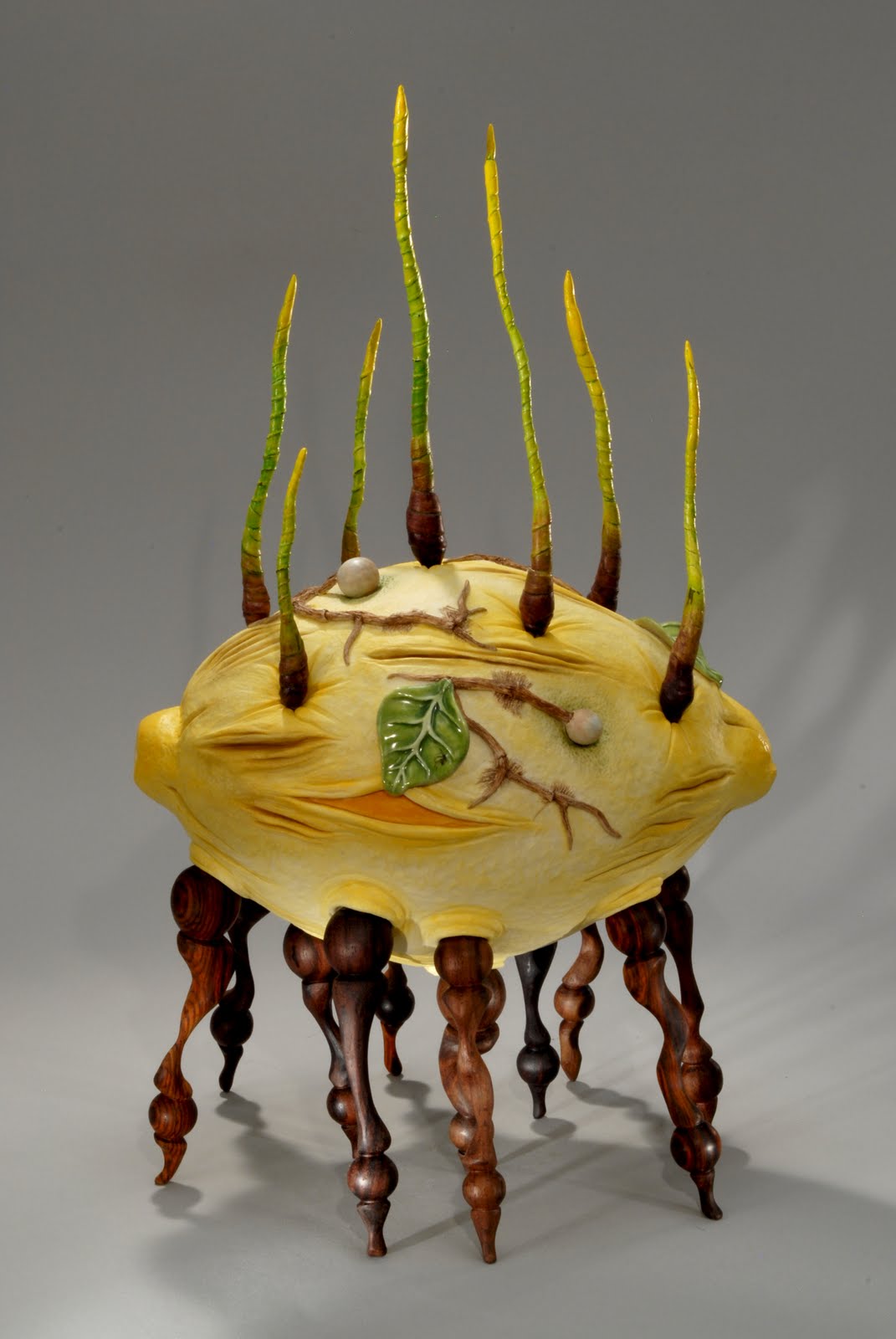
Two staff members also chose Jason Kishell’s Stilted Lemon Growth. Suzanne Sippel, Asher Gallery Retail Manager, wasn’t sure how to describe why, but said, “I like the monstrous lemon, and considering the dreadful things I put lemons through with my tea... well, this is their revenge!”

Curatorial Fellow, Susie Silbert, states, “With so many great pieces in the exhibit, it’s hard to choose just one favorite (well, for me just one favorite is always an issue). Today, I would choose Jason Kishell’s Stilted Lemon Growth. Its craftsmanship is amazing—Kishell’s commitment to his materials and ideas is evident in his close attention to detail in all aspects of the work’s execution, from the detailed veining of the roots on the lemon’s surface to the multi-axis lathe work on its many wooden legs. Stilted Lemon Growth looks like an emissary from a fully formed world inside Kishell’s imagination, leading me to wonder who the other inhabitants may be. The object has the playfulness of a fairytale, the high definition of a video game and enough surface information to keep me interested for quite some time.”

Jason Kishell, Stilted Lemon Growth.
Porcelain, polymer clay, wire,
Indian rosewood. 9” x 11” x 19”

Curatorial Assistant, Ashley Powell, chose Rough Neck by Edward McCartney. McCartney’s clever use of materials is what really struck her, the way he has re-contextualized motor oil through its usage in an object of adornment. Just as so many other valuable natural resources are used to make jewelry, oil has now been fashioned into charms or gems of “black gold,” reminding us of how much of a commodity it is to our contemporary society.