Showing posts with label HCCC. Show all posts

February 29, 2012

AIR Interviews: Paula Haymond

This week, we’re sharing the third in a series of interviews featuring our current artists-in-residence. Paula Haymond is a woodturner who combines many different woodworking techniques, as well as acrylic paints and metal, to create three-dimensional works of art.  Haymond is often inspired by the natural world, and she seeks to explore the relationships among color, imagination, form and texture to express the wonder she so often found in the woods, lakes and open pastoral scenes of her native Indiana. She is a member of the Gulf Coast Woodturners Association and has taught classes in wood turning, piercing and embellishing at local workshops and regional symposia. Haymond has been accepted to be a mentor for the Virginia Symposium of Woodturners in 2012 and is the vice president elect of the Southwest Association of Turners. She will be with HCCC through May of 2012, so please feel free to stop by her studio, chat with her, and witness how she’s transforming her media to create fantastic and often whimsical story-telling pieces. 

Paula Haymond. Texas Wetlands, 2012. Mesquite, turned, carved,
pierced and wood burned. Photo by HCCC.

Paula Haymond. Sea Creatures, 2012. Texas ebony, turned, carved,
pierced and textured. Photo by HCCC.
Tell us a little about the current body of work.
I find myself going in multiple directions with a focus on altering the wood, which is initially turned on the lathe, into forms using texture, pyrography, piercing and air brushed paints to create either pictures or creatures.  My pictures often involve garden scenes with butterflies, hummingbirds and dragonflies, with floral designs pulling the story together.  My creatures appear somewhat alien or anthropological with carved appendages.  I like using the wood as a canvas but try to create a relationship between the piece and the viewer so that their natural curiosity draws them in closer to find hidden surprises in the pieces.

What drew you to wood as your medium of choice?
I have always been drawn to wood as a property for building objects, but it was the lathe that changed my relationship from hobbyist to artist.  I like the wide variety of woods that are available to turn, as well as the many possibilities that I find inspiring in the grain and figure of each piece of wood.  Even when I intend to cover the surface with my designs, I first take into consideration what that piece of wood will support and how I will work with it to create something new.

How would you describe your work?
I see my work as dynamic and changing.  I love variety and am, for better or worse, always looking for a new angle on creating images which have an impact on the viewer.  I like to create the illusion of the wood being some other type of material, such as metal or ceramic.  When the viewer says “wow,” or “that really looks like ceramic,” I think I have captured their imagination and they are intrigued by what I have created.  I like to encourage them to pick up pieces and really relate to them.

What are the woodworking techniques you use?
Every piece I create starts on the lathe.  If the wood is light colored, then I am more likely to want to use acrylic transparent airbrush paints along with creating a background of textures, lace work, and pyrography.  I use a high-speed dental drill to accomplish the lace work and then a variety of burs to create textures.  I often either draw or transfer images onto frisket or directly to the wood to cover the piece in a revolving set of images to pull the images together.  When I carve, I use an NSK micro motor with burs, sandpaper, and cutters to remove wood quickly.  Most of my pieces have hours of hand work involved in them to reach the final three-dimensional objects.

Many of your pieces include color pigment designs. Have you always used color in your work?

No, I started out as a purist, calling on the natural beauty of the wood to be the only dimension I was interested in showing off.  I think most wood turners start with the idea that the beautiful wood is all one needs to create enjoyment.  Although that can be true, for me, I needed to become more involved in what was happening to the wood beyond the lathe. I have a vivid imagination, and I was able to see characters in the grain of the wood, which I wanted to accent, and that lead to carving away the parts of grain that clouded the images I saw.  Carving away wood just lead down a path of further exploration, and I still seek out new ways to add to the character of wooden objects.

Paula Haymond. Butterfly Garden, 2012. Silver maple, turned,
pierced, air brushed and textured. Photo by HCCC.

Woodturner Paula Haymond in her studio at HCCC. Photo by HCCC.

What types of wood do you work with? Is there a particular kind you prefer, and why?
Currently I am turning more green wood than kiln-dried wood.  In the Houston area, I really find silver maple, magnolia and hackberry to be great woods for turning thin-wall vessels.  By thin, I mean less than 1/16th of an inch in thickness.  This allows for piercing with the dental burs, which are the same burs the dentist uses to take out cavities.  Much thicker walls on the vessels and the bur is not able to cut all the way through the wood at once.  I am also exploring turning green mesquite and Texas ebony, which are very dense hardwoods.  They are very easy to carve and texture, despite their hardness.  They also hold up to the thin-wall turning I do.  Because of their strong grain patterns, they do not lend themselves to coloring.

What are you doing when you’re not creating works of art from wood?

I am a licensed psychologist and am still running a practice in Katy.  We focus on carrying out psychological and neuropsychological assessments for the Department of Assistive and Rehabilitative Services, as well as for Social Security Disability.  Currently, I am working seven days per week while in the AIR program.  It continues to be a fabulous opportunity for me.

January 16, 2012

CraftTexas 2012 Juror Jade Walker

CraftTexas 2012 is just around the corner! The call for artists will close on March 15, and the exhibition will run from September 29 - December 30, 2012. All of us at HCCC are looking forward to this, our seventh in a series of juried exhibitions showcasing the best in Texas-made contemporary craft. We are especially excited to have Jade Walker, an Austin-based artist and Director of the Visual Arts Center and the Creative Research Laboratory at the University of Texas at Austin, as one of our three jurors.

Walker is an active participant in the Texas visual arts community and, along with her day job as the director of the Visual Arts Center in the department of Art and Art History at the UT Austin, she has her own rigorous studio practice. On January 20th, an exhibition of her work, titled Contact, will open at Lawndale Art Center, our awesome next-door neighbor. The exhibition features an array of characters--some fictional and some real--permeated by physical breakdown and includes several sculptures and sculpture-based installations that are inspired by the physical repercussions of trauma on the human body.

Jade Walker,  Figures # 6.
Fabric, hat rack, mixed media
59” X 40” X 60" 2009
.
Photo courtesy the artist.

Jade Walker,  Figures # 6 (rear view).
Fabric, hat rack, mixed media
59” X 40” X 60" 2009
.
Photo courtesy the artist.

On October 5, 2011, the LVL3 exhibition space in Chicago had a post on their blog naming Jade Walker their “Artist of the Week,” and it included a short interview with the artist. When asked how to explain her work to a stranger, Jade responded, “My practice is a mixture between an exploration of materials (fabric, rubber, found objects, crusty old paints, tool-dip and whatever else I can get my hands on) and my desire to reproduce the human body.  I am interested in the mechanics of gender, both physically and symbolically, and that interest patinas the work as well.”

Walker’s exhibition at Lawndale could not be on display at a better time, as it will be an incredibly enjoyable opportunity to acquaint ourselves with her as a person and as an artist. CraftTexas 2010 is most definitely one of my favorite exhibitions that have been on display since I became part of the HCCC family in early 2010, and one of the reasons is the incredible variety of work that is submitted. Work in every craft medium, as well as both functional and non-functional work, is selected. I am thrilled to see what craft artists around Texas are currently making, and we hope that Walker enjoys participating in the jury process just as much as we enjoy putting the exhibition together.

Jade Walker, Trophy Room (detail 1).
Vacu-form panels, plastic, leather, found objects.
Site-Specific installation: 12’ X 11’ X 8’
Domy Books 2009. Photo courtesy the artist.
Jade Walker, Trophy Room (detail 2).
Vacu-form panels, plastic, leather, found objects.
Site-Specific installation: 12’ X 11’ X 8’
Domy Books 2009. Photo courtesy the artist.

The CraftTexas series began in 2002 and is one of the most exceptional and significant exhibitions in the Texas craft community. And, for HCCC, it is an event deeply rooted in the core mission of our organization. It serves as a starting place for the general public to appreciate the depth and breadth of craft being made in our own communities and across the state.

--Ashely Powell, Curatorial Assistant

To learn more about how to apply to CraftTexas 2012, click here.

If you would like to read more about Jade Walker and view more photos of her work, check out her website: http://jadewalker.org/

Click here to read the Lawndale press release that includes info on her exhibition.

January 3, 2012

Thoughts on SPUN

Needlepoint artist and Society for the Prevention of Unfinished Needlepoints (SPUN) founder, Mary Smull, came to HCCC for two events in early December. Smull is one of the artists featured in HCCC’s current exhibition, Beyond Useful & Beautiful: Rethinking Domestic Craft. Curator Anna Walker shares her thoughts on her work and the events.

I’m guilty of procrastination. There, I said it. I think it is something that everyone struggles with to some degree. I definitely remember it as a common excuse for many of my friends in school. What I find interesting about procrastination is the different ways and various projects that are unique to the procrastinator.

For instance, I’m known for beginning a project, getting it most of the way complete and then leaving the ending undone. This is true of the simplest tasks, such as mailing a birthday gift to a friend. I buy the gift, wrap it, and then it sits for weeks--sometimes months--in my office awaiting a short trip to the post office.

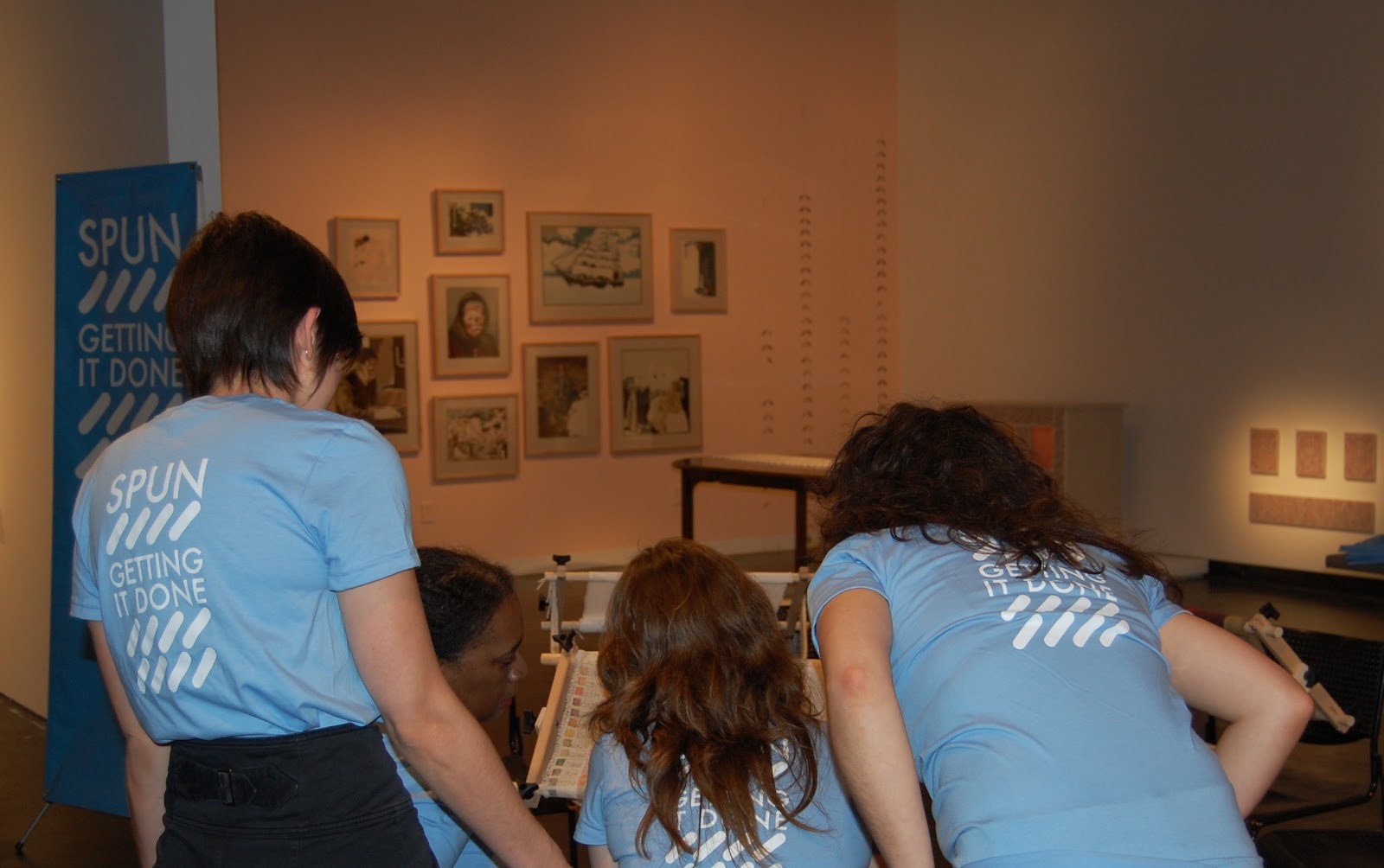
Through my personal experiences of “unfinished labor,” I am able to better appreciate the motivations behind Mary Smull’s Unfinished Needlepoint series.  Smull purchases unfinished needlepoints and completes them using only white thread, visually calling attention to that which was left undone, but also recognizing the labor invested by an anonymous hand. At the beginning of December, Smull brought her “Society for the Prevention of Unfinished Needlepoint” (SPUN) to our large gallery. A bright blue banner signaled the event, and representatives in matching blue t-shirts were there to assist visitors in completing stitches for the cause. (Click here to see the event photos.)

At Friday’s group therapy session, Finish Fetish, with artist Mary Smull.


SPUN representatives who helped “get it done.


Each visitor brought stories about their own unfinished projects, and we even had a visitor bring her own unfinished needlepoint in hopes that she would be inspired to complete it after talking with the artist. We talked extensively about the feelings associated with incompletion, guilt, avoidance, curiosity, even apathy. Looking back on the conversations, one area we did not spend as much time talking about were the reasons or thoughts on why works were left unfinished. Was it out of boredom with the project, competing external demands, or pure forgetfulness? 

I have to be honest--I even procrastinated on writing this post and on the previous assignment from Curatorial Assistant, Ashley Powell, which you can read about here.  What caused me to not even begin these projects? I would like to think it is because I had competing external demands, and that is partly true. However, for me, I recognize a fear of whether the finished project lives up to my initial expectations and standards. During Friday night’s discussion, Finish Fetish, we talked specifically about writing projects. How some of us never feel resolved about writing, and I agreed--writing can always be changed; it seems to constantly be under revision, editing, and perfecting. Perhaps, this is why I feared beginning the post, as I knew I might not reach the “finish.”

Above is an HCCC volunteer/SPUN representative assisting a
visitor at one of the unfinished needlepoint stations.


The counterpoint to SPUN’s blue t-shirts:  a group of ladies from “Oktoberfest,”
clad in pink t-shirts commemorating 27 years of gathering together.


You can follow Mary Smull’s “Society for the Prevention of Unfinished Needlepoint” on her website http://www.unfinishedneedlepoint.org. Her work is part of the current exhibition, Beyond Useful & Beautiful: Rethinking Domestic Craft at HCCC through Sunday, January 8, 2012.

-- Anna Walker, Curator

December 7, 2011

AIR Interviews: Leslie Shershow

This week, we share the second in a series of interviews with our current artists-in-residence (AIRs). Leslie Shershow is a metalsmith and jeweler from the small town of Belfast, Maine. After graduating from the Massachusetts College of Art with a BFA in metals, she stayed in the Boston area to further develop her jewelry at her studio in Somerville, MA, exhibiting her work in various group shows around the country. Prior to joining HCCC as an artist-in-residence, she taught metalsmithing to children and adults in various art centers and colleges in the Boston area and managed the metalshop at the School of the Museum of Fine Arts  for several years. She has been with HCCC since August and will be here through March, 2012. 


Diamond Rings by Leslie Shershow (plastic). Photo courtesy the artist.


Leslie Shershow. Diamond Ring, 2011.
Copper, brass, silver, auto paint. Photo courtesy the artist.

Tell us a little bit about your work.

Right now I'm inspired by wonky home improvements and functional crafts. I find much beauty in the way a novice craftsman might fix his home--I'm interested in the evolution of a domestic structure due to regular maintenance. I tend to work the same way--by starting with an object and scrounging for the part that will turn it into a functional piece of jewelry. The theme is pretty nostalgic for me--I grew up in Maine, so I use fishing and nautical imagery, along with funny home-maintenance things my dad used to do.
 
How did you get your start making jewelry?
I had first learned a little metalsmithing in high school crafts class and hated it. I melted my first project!  Later, in college, when it was time to choose my major, I was really impressed by the work that came out of the metals department, so metals is what I chose.

Where do your ideas come from? 
Everything, really. I guess my work comes out of interests that keep surfacing over and over again.

Leslie Shershow's necklace from the Home Improvement Series. Photo courtesy the artist.

Leslie Shershow's bracelet from the Home Improvement Series. Photo courtesy the artist.

What artist or designer do you admire, and why?
Iris Bodemer is one of my favorite jewelers (among many). I admire her because, in a lecture, she told us she took out a bank loan in the form of a gold block and proceeded to slice it into jewelry. That is very admirable to me.

In your bio, it says that you’ve taught metalsmithing to both children and adults. What do you enjoy most about teaching? What is it like teaching metalsmithing to children?
I really enjoy the challenge. Metalsmithing embodies so many different techniques, and many times, there are multiple ways to do something. I mostly taught small classes, so I had to work with each student individually to see what methods work best. Teaching children can be really difficult.  Metalsmithing is a tedious and time consuming practice, and there isn't much instant satisfaction. It's hard for kids to sit down and sand for hours, especially when they're wound up from a day at school and candy they got from 7-11.
 
What are you doing when you’re not creating?

I like hanging out with the other lovely AIRs and HCCC staff, visiting museums, and going for runs. Lately, my boyfriend and I have been working on a large stained-glass terrarium to prevent our cats from eating our plants. 


 Metalsmith and jeweler, Leslie Shershow. Photo courtesy the artist.


Describe yourself in five words.

I like to make things.

Being a Northerner, is there anything you find humorous or strange about Houston? I think it's funny that a lot of people in Houston's public places are either really dressed up or in their gym clothes. I come from a place of in-betweeners.

December 1, 2011

Needlepoint & Group Therapy with Mary Smull

Needlepoint artist and Society for the Prevention of Unfinished Needlepoints (SPUN) founder, Mary Smull, will be at HCCC for two events this weekend. Smull is one of the artists featured in HCCC’s current exhibition, Beyond Useful & Beautiful: Rethinking Domestic Craft and will be hosting two community events this weekend in the large Gallery at HCCC.


Mary Smull and participant at a recent SPUN event.
Mary Smull, Old Woman, 2008. Found unfinished needlepoint completed by
artist using only white yarn. 19 ½” x 23”. Photos courtesy the artist.


Smull’s work and SPUN deal with completing an object of labor--something that was abandoned and unfinished, despite the arduous effort put into the project. She is creating a sense of absolution for this occurrence that most everyone has experienced in one way or another. With our anticipation for these upcoming events, we thought it would be amusing to share some of the works that have been left unfinished by our staff members and artists-in-residence.

I sent out an email requesting a photograph of an unfinished work, a brief description, and why it was left incomplete. Fittingly, I received zero responses. This is most likely due to the inherent guilt people experience when time is invested in a project that has been left incomplete indefinitely and their reluctance to be an example. Humorously, because of this, I was now left with an incomplete project, being unable to actualize this blog post in the way I had intended.

I am hoping that the event on Friday evening will give me more insight into the realm of incompletion and all of the intense emotions that come with this territory. So, if you find yourself filled with anxiety or guilt about projects that have been abandoned around your house, then please join us for a conversation with Mary Smull for Group Therapy – Finish Fetish, Friday, December 2, from 6:00 – 7:00 PM.

If you are unable to join on Friday, Mary Smull will also be present on Saturday, December 3, from 1:00 - 4:30 PM, to host a SPUN session in our large gallery. SPUN is a community needlepoint project, founded by Smull in 2009 to “eliminate the worldwide phenomenon of unfinished needlepoint,” and has been rescuing incomplete works through performances across the country. You are invited to participate by completing stitches in unfinished needlepoint projects. Needlepointers of all abilities are welcome! Once complete, these works will be archived as part of SPUN’s collection. To learn more, visit the SPUN website here: http://www.unfinishedneedlepoint.org/

This is a great opportunity to release a little residual guilt or anxiety you may have and also help support SPUN’s mission, to prevent any needlepoint project from going unfinished. We hope you will join us for these two exciting and engaging events!

--Ashley Powell, HCCC Curatorial Assistant

November 8, 2011

Heidi Gerstacker Trunk Show – Coming Soon!

This week, Asher Gallery Manager, Suzanne Sippel, shares her thoughts on Houston metalsmith and jeweler, Heidi Gerstacker.

I have worked in the Asher Gallery at Houston Center for Contemporary Craft a little over four years. When I first started here, my mind was boggled by how many jewelers I represented, along with the sheer breadth of aesthetics and techniques. Having spent some time with fine jewelry in my former life, it was fun to start looking at fine-craft jewelry and seeing each piece as part of a larger oeuvre and not necessarily as client-driven work. There’s a great feeling when artists explain their techniques and passions. This was something I really enjoyed as I got to know Heidi Gerstacker.

Heidi has been represented by the Asher Gallery since November 2002 and has also been an active part of HCCC since its inception. She is active in the arts community in Houston and is part of its bloodlines.  Having attended jewelry classes at Bellaire High School and earning her MFA from the University of Houston, Heidi is an integral part of Houston’s metalsmithing tradition.  As we got to know each other, I was struck by how rare this is.  We may have many transplants and late-bloomers, particularly in fine craft, but there are few born-and-bred Houston career artists.

Working primarily in sterling silver, Heidi has created a consistent body of work over the years. Upon hearing marquise, most people think of diamonds or bad romance novels, but those in the know think of Heidi’s work. This shape forms the basis of her production jewelry. The crisp clean edges of the marquise bring out the strength of the precious metals and the precision of the maker’s hand. I believe this is what accounts for the timeless look that her pieces hold. They would and will feel modern, regardless of the era. But this is not the only part of Heidi’s aesthetic. She looks for the balance between having production pieces and defining one-off studio work. This is a difficult line for many artists to walk—creating works that can support their careers, while still producing the art that drove them into their fields initially.

Heidi Gerstacker, Marquise Pendant, sterling silver, moonstone, 2010.
Photo by the artist.

Leaf Brooch, sterling silver, moonstones, 2011. Photo by the artist.

It is this balance that you will find at Heidi Gerstacker’s Trunk Show at the Asher Holiday Soiree on November 17th.  You’ll find both stunning original pieces and the classic jewelry that has made Heidi a household name on the Houston jewelry scene. This is a special event for the Asher, as it is our first trunk show with Heidi in many years. It’s also rare to find so much of Heidi’s work at one time, so do not miss this opportunity! 

We’ve scheduled this event to fall on the first evening of the Houston Museum District’s Member Sale. With a current membership (at HCCC or any of the museums in the District), you’ll receive a 20% discount off your purchases (some restrictions may apply). We have made it as easy as possible to add to your collection of Heidi Gerstacker jewelry or to cross names off your holiday gift list. Now it is up to you to visit us!  Heidi’s trunk show will take place Thursday, November 17, 5:30 – 8:00 PM, and Saturday, November 19, 11:00 AM – 4:00 PM. Please come early for the best selection—once we’re out, we’re out!

--Suzanne Sippel, Asher Gallery Manager

October 25, 2011

AIR Interviews: Celia Butler

This week, we are posting the first in a series of interviews with our newest artists-in-residence. Celia Butler, from Carbondale, IL, is a mixed-media artist who holds a MFA from Cranbrook Academy of Art and a BFA from the Kansas City Art Institute. She has been with HCCC since August and will be here through the end of November. Be sure to come in and check out her studio before she leaves! To learn more about HCCC’s Artist-in-Residence Program, click here.

Celia Butler. Sugar Gazing, 2011. C print. Photo courtesy of the artist.

What kind of work do you make? 
I make work about fantasy and the over-idealized female, which I see as a strange combination of adolescence, sexuality, and perfection. The images I create are of a youthful and innocent female wearing a sugar bow some place on her body. Currently, I'm working on a life-sized porcelain doll that I will photograph similarly to my other photographic work. I'm also working on some heavily adorned, adult-sized baby bibs for the doll to wear. And, yes, I realize this sounds weird.


What is sugar pulling? Can you explain the process and how it became part of your work? Sugar pulling is a process in which you literally pull a hot sugar mixture until it becomes glossy and ribbon-like. Most people are familiar with ribbon candy, which is made with the sugar-pulling method.

I had previously been making work about adornment but decided that, instead of using bows made from real ribbon, I would use ones made from ribbon candy. Making the bows from sugar facilitates a critique on the contemporary idealized female because it implies an oversaturation of sweetness, innocence, and fragility. Candy's oral nature also suggests sexuality.

Celia Butler. Photo by Erin Sweeny and Brittany Nelson.

Are there any artists or designers who you are inspired by?
I think that artists who have successfully managed to make their studio practice their full-time job are pretty inspiring.

Where do you see yourself in 10 years?
Still making art.

What is your favorite thing about Houston?
Favorites are hard—and I've only been here for two months—but Houston's art scene seems to be busy and well supported.

Can you tell us something we’d be surprised to know about you?
My cell phone is broken and displaying everything upside down and backwards. If I haven't responded to your text, it's because I'm still trying to figure out what it says.

Who would play you in the movie of your life?
I'm assuming I'll be dead before that ever happens, so the casting director can just choose for me.


September 1, 2011

Staff Favorites from "Crafting Live(s): 10 Years of Artists in Residence."

With the closing of Crafting Live(s): 10 Years of Artists-in-Residence rapidly approaching, we asked the staff of HCCC to share what their favorite pieces are and why. The exhibition contains works by 36 artists who have participated in the Artist-in-Residence Program here at HCCC during the past 10 years. If you’ve seen the show, please share your favorites in the comments below! If you haven’t, then hurry in, the show closes this Saturday, September 3!

Julie Farr, Executive Director, had a particularly difficult time picking just one favorite piece. Farr explains, “I think it’s because so many of these artists have become our colleagues and friends, and we’ve seen them in process and progressing during their residencies. When the exhibition first opened, I was excited to see how far everyone pushed themselves by making new, meaningful works. I love that both the residency experience and HCCC are a safe haven for exploration, growth and creativity in action.”

Communications Director, Mary Headrick, chose 6 Degrees by Cathy Cunningham-Little. “I think it’s an absolutely stunning installation. The suspended rain-drop-like forms, the amount of light and reflection they create, and the fact that the artist created them from silvered glass is fascinating.  These are complemented by the metal pieces below, which cast wide and interesting shadows."

Cathy Cunningham-Little, 6 Degrees
Etched, stainless-steel ladles and silvered
blown glass. Variable dimensions.

Curator, Anna Walker, chose the imaginary children by Bethany Rusen for two reasons. “One, I’m drawn to works that have a haunting presence and anthropomorphic gesture. But also, I grew to love this piece during installation. Constructed of a nylon fabric stuffed with polyfill, then dipped in clay slip, the forms are awkward, pliable and yet also brittle when handled. On the wall I have a similar reaction to the work as when I held it, and I enjoy that those two interactions complement each other.”

Education Director, Miriam Mendoza’s favorite is Friends by Ann Trask. This piece is made from used tea bags, reclaimed wood pieces, fimoclay, tea-stained muslin and wax. Miriam greatly appreciated the artist’s use of everyday objects, things many people would deem as trash, and re-contextualizing them into objects with meaning. These tea bags are not just trash, but a remnant of the experience of enjoying a cup of tea with a friend. The tea bags have become symbols of the artist’s many relationships and friendships. To Miriam, the piece conveys an important message of not taking for granted the objects and people present in our everyday lives. Miriam also finds the piece to be aesthetically pleasing.

Ann Trask, Friends. Used teabags, reclaimed
wood pieces, tea-stained muslin, wax. 73” x 50” x 4"

Jenny Lynn Weitz, Marketing and Web Assistant, chose Darryl Lauster’s Runners Up Presidential Plate Series. “I like the fact that Lauster is attempting to commemorate the losing candidates by depicting them on hand-cast porcelain transferware, and even though the stories behind each portrait involve a lot of important political, social and economic issues, I find the installation humorous and sad at the same time.”

Associate Director of Fundraising, Nyala Wright’s favorite is also Darryl Lauster’s Runner’s Up Presidential Plate Series. Nyala chose this as her favorite because the installation of plates is historically informative with an outstanding sense of humor.

Darry; Lauster, Runners-Up Presidential Plate Series. 28 individual
hand-cast porcelain transferware plates. 12” x 12” x 1" each

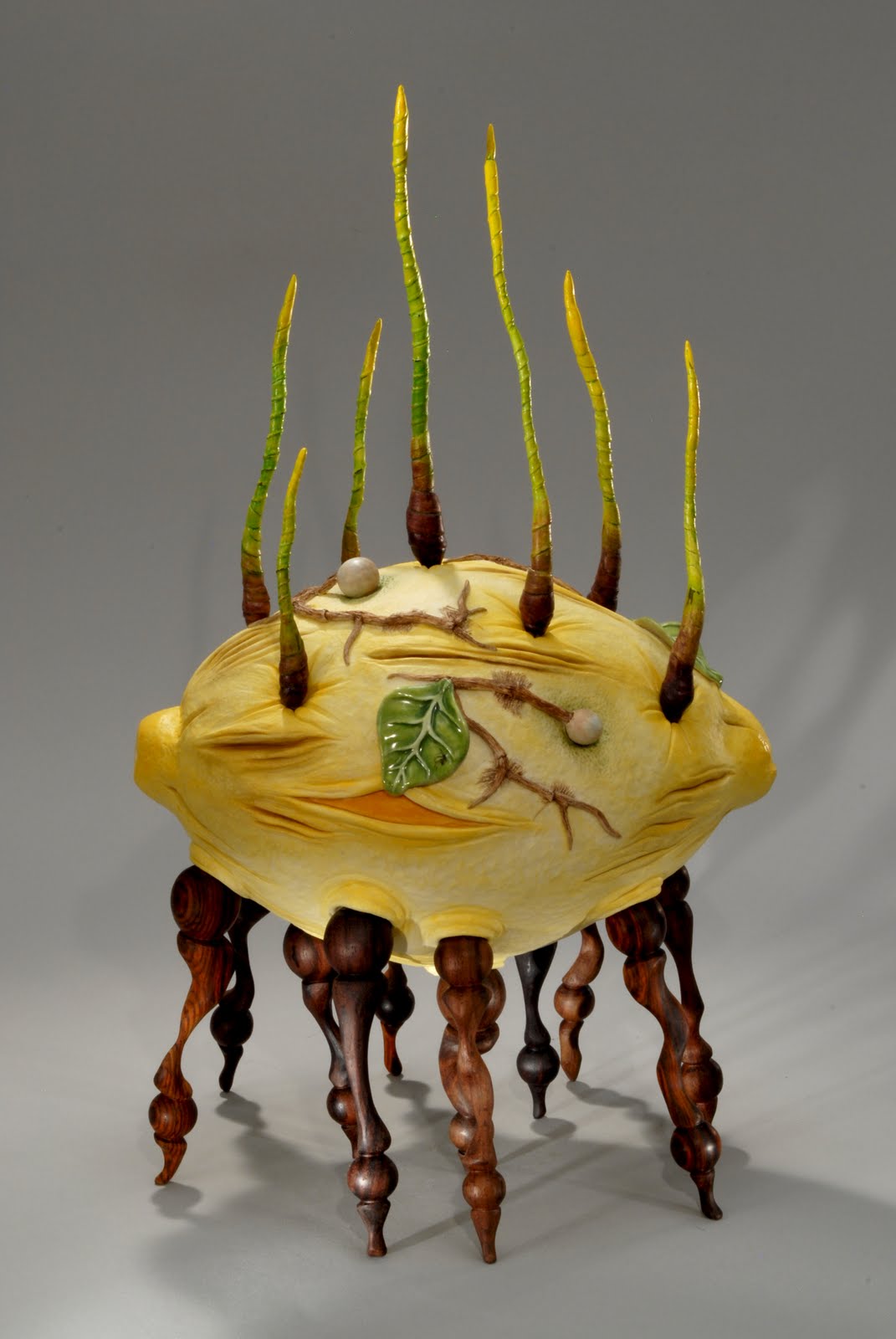
Two staff members also chose Jason Kishell’s Stilted Lemon Growth. Suzanne Sippel, Asher Gallery Retail Manager, wasn’t sure how to describe why, but said, “I like the monstrous lemon, and considering the dreadful things I put lemons through with my tea... well, this is their revenge!”

Curatorial Fellow, Susie Silbert, states, “With so many great pieces in the exhibit, it’s hard to choose just one favorite (well, for me just one favorite is always an issue). Today, I would choose Jason Kishell’s Stilted Lemon Growth. Its craftsmanship is amazing—Kishell’s commitment to his materials and ideas is evident in his close attention to detail in all aspects of the work’s execution, from the detailed veining of the roots on the lemon’s surface to the multi-axis lathe work on its many wooden legs. Stilted Lemon Growth looks like an emissary from a fully formed world inside Kishell’s imagination, leading me to wonder who the other inhabitants may be. The object has the playfulness of a fairytale, the high definition of a video game and enough surface information to keep me interested for quite some time.”

Jason Kishell, Stilted Lemon Growth.
Porcelain, polymer clay, wire,
Indian rosewood. 9” x 11” x 19”

Curatorial Assistant, Ashley Powell, chose Rough Neck by Edward McCartney. McCartney’s clever use of materials is what really struck her, the way he has re-contextualized motor oil through its usage in an object of adornment. Just as so many other valuable natural resources are used to make jewelry, oil has now been fashioned into charms or gems of “black gold,” reminding us of how much of a commodity it is to our contemporary society.

August 25, 2011

SPIN 7: Look Forward One-Night Exhibition & Dance Party

SPIN 7: Look Forward One-Night Exhibition & Dance Party
Friday, August 26, 8:00 – 11:00 PM
at Houston Center for Photography, 1441 West Alabama


All of us at HCCC are thrilled that Houston Center for Photography (HCP) invited us to partner with them this year for the event, Spin 7: Look Forward.  This is the 7th annual Spin “friend-raiser” at HCP, and this year’s theme, Look Forward, is fitting for both organizations, as HCP celebrates its 30th anniversary and HCCC celebrates its 10th. 

The one-night exhibition and dance party is a fantastic opportunity for the organizations, their audiences and the Houston community to mix and mingle, celebrate the summer, and participate in the creation of an interactive experience. 

In 2008, I had the pleasure of volunteering at Spin 4: Lens Libs, a party inspired by the word game, “MAD LIBS.” That evening, my responsibility was to go around the gallery and rotate photographs in and out of the giant “MAD LIBS” games that decorated the gallery walls from ceiling to floor. We used the photographs that people had submitted in advance or that partygoers brought with them to “fill in the blanks” on the walls, which created a sensational communal experience. I am sure this year’s event will be just as imaginative and amusing!

For Spin 7, party guests are asked to bring photos that reflect their personal outlook or opinion on the future of photography and/or craft. These photos will be exhibited for one night only.  In addition, artist Lori Hepner is designing a light-and-motion installation, which will respond to participants' tweets regarding the future of photography. A DJ, photography-based games, interactive photo booth, cold beer, and delicious food will round out the party. We hope you will join us tomorrow to celebrate the bright futures of HCCC and HCP!

--Ashley Powell, Curatorial Assistant at HCCC

Ticket prices:

**HCP and HCCC members: $10

Advanced purchased (on HCP's website): $15

General Admission/at the door: $20

** In order to purchase discounted tickets online, HCCC members should email Marina Lewis at mlewis@crafthouston.org to receive your online code.

Get your tickets online here.