Showing posts with label Papermaking. Show all posts

April 22, 2011

Curatorial Assistant, Ashley Powell, on Installing Michelle Samour’s Lightbox

Michelle Samour’s show, Truth and Transience, is comprised of three parts. The pieces Eyes of God: Conversations about Science and Faith and Bundle are both wall installations. The third piece in the exhibit, Reflecting Pools: Beautiful Viruses, is a 10-by-3.5-foot light box that sits on the floor in the middle of the gallery radiating fluorescent light. The light box was constructed specifically for this installation and is filled with bright hand-made paper shapes the artist calls viruses.

The imagery Samour uses to create her viruses is from actual diseases such as SARS, Smallpox, Ebola, Avian and AIDS. She has created a self-contained aquatic garden of viruses that invites the viewer to contemplate the heavy issues that surround disease and medicine in our contemporary society—such as efforts to control the spread of disease; the control of mass hysteria; the creation of vaccinations; and the political, social and economic factors that surround development of vaccines.


Michelle Samour, Reflecting Pools: Beautiful Viruses (detail),
Pigmented hand poured paper/vellum, light. Photo by Robert Schoen.


Samour makes these viruses out of abaca, a fiber found from the banana tree. She mixes the abaca fibers with water and macerates them in a machine called a beater until it resembles a fluid paste. The fluid paste or slurry is then colored with light, fast pigments. The shapes that are floating in Reflecting Pools: Beautiful Viruses are drawn using a squeeze bottle. The slurry is simply squeezed out of the bottle into various shapes, pressed and then dried.

These vibrant and beautifully translucent papers were carefully distributed and organized on a layer of milk plexi-glass and then glass. Samour first worked slowly and purposefully, positioning the viruses on the layer of milk plexi-glass. After the works were in place, the next step of the installation was inserting the sheet of glass on top of one layer of plexi-glass and abaca. Unloading the glass and carrying it into the gallery was an arduous task and required the strength of three men: Alfonso Cipriano, head carpenter at MFAH; his supervisor; and Randall Dorn, Facilities and Operations Manager at HCCC.


Above from left to right:
Randall Dorn, Facilities and Operations Manager at HCCC; MFAH staff member;
Alfonso Cipriano, MFAH Head Carpenter; Anna Walker, Curator at HCCC;
and Ashley Powell, Curatorial Assistant at HCCC.

Once the glass was in the gallery, all of us, including Michelle Samour, Curator Anna Walker and myself, cleaned the surface of the glass. We made sure to remove any and all smudges, dirt, fingerprints, etc., so that this labor-intensive task of lowering the glass down into the box only had to happen once. Handles with giant suction cups were attached to one side of the glass, and the rest of us stood back, held our breath and watched as the glass was lifted and then slowly lowered into the light box. Once that was in place Samour added another layer of abaca viruses. The two layers provide a sense of depth to the light box and it takes on the appearance of a pool of water containing floating microscopic agents, reminiscent of what would be seen if these viruses were viewed under a microscope. I think a sense of relief washed over all of us after this part of the show had been safely put together, and the exhibition was two thirds of the way complete.

Alfonso Cipriano (MFAH Head Carpenter) and
HCCC Curator, Anna Walker.


Ashley Powell
Curatorial Assistant
Houston Center for Contemporary Craft

April 14, 2011

Curatorial Assistant, Ashley Powell on Michelle Samour’s Installation

A couple of weeks ago Anna Walker, Curator, and I had the fantastic opportunity to assist artist Michelle Samour in the installation of her show, Truth and Transience, which is now up in the small gallery through May 15, 2011. Getting to know the artists, being able to watch them work and becoming a part of the creative process is always an awesome experience and working with Samour was no exception.

The show includes two wall installations, with the walls covered in hand-made pigmented abaca paper circles that have designs meticulously painted in gouache. In the middle of the gallery is a 10 by 3 ½ foot light box that glows.

Curator, Anna Walker, installing Michelle Samour's
Eyes of God: Conversations about Science and Faith

The piece, Eyes of God: Conversations about Science and Faith, was the first piece of the exhibition to go up. Samour brought a template the size and shape of the space she wanted to fill with her abaca circles. This template, which you can see in the picture above, was taped on the gallery wall and provided the exact area for her abaca circles. The oval shape resembles a giant open eye similar to the Eye of Providence (or the all-seeing eye of God) found on the reverse of the Great Seal of the United States, which also appears on the Unites State’s one-dollar bill.


Anna Walker and Curatorial Assistant, Ashley Powell, arranging the abaca circles of
Michelle Samour's  Eyes of God: Conversations about Science and Faith.


Afterwards, the template was brought down and stretched across six eight-foot tables. All of the beautiful, vibrant and translucent abaca circles were then taken out and arranged onto the paper template. To help arrange the circles the template was divided into four quadrants. We used blown up photographs of a previous installation as our guide and worked one quadrant at a time, leaning and stretching across the tables to deposit the circles of paper onto the template. It quickly became an amusing puzzle of trying to replicate the arrangement in the photos. All the while, we noticed the patterns Samour had created with the specific placement of the various colors and sizes of circles.


The artist installing the pieces she made for the exhibition.

Once we had all of the abaca circles in their place on the table, it was time for us to hand them to Samour, one by one, as she stood on a ladder and recreated the piece on the wall. She would sporadically stop to improvise and switch the order of the pieces or slightly alter their placement. We started handing her the circles from the very center of the 4 quadrants and gradually worked our way out one circular layer at a time. The further along we got, the more interesting the installation became visually. As the individual pieces were viewed collectively on the wall, they start creating a three dimensional optical illusion. The entire form started to take shape. Once we were done, there was an excellent sense of accomplishment. I was thrilled to have been able to participate and to have the up close and personal vantage point to view how Michelle Samour works. Stop by HCCC to see the finished installation, the exhibit is open through May 15!

Ashley Powell,
Curatorial Assistant
Houston Center for Contemporary Craft


September 2, 2010

September's Hands-On Houston

Everyone has heard paper comes from trees, but do you know how a tree is made into paper? If you want to find out, join us this Saturday, September 4, for Hands-On Houston! On the first Saturday of every month, from 11 a.m. - 3 p.m., HCCC hosts Hands-On Houston, a free craft-making activity that people of all ages can enjoy. This Saturday, visitors will be up to their elbows in paper pulp and water, making their own sheets of handmade paper. Papermaking artist Kathy Gurwell will be leading the activity.


Kathy is an instructor at the Museum of Printing History and has had years of experience in the fields of both papermaking and printmaking. Below she shares about her experiences as a papermaker:


I found my way to papermaking through printmaking. As a curator at Tamarind Lithography Institute in Albuquerque, NM, from 1971-1973, I had to know and work with fine quality paper. Later, in California, I had the opportunity to hand make paper, and, eventually, in 1976, I bought the equipment and set up my studio.


I create paper by deconstructing clothing from natural fibers, such as cotton, linen and silk. Then, after beating the fibers to a pulp, I reform them into sheets of hand-pulled paper. Besides making papers from natural fibers, I have also made Japanese paper out of the inner bark of the kozo and gampi trees. When created, Japanese papers are amazingly thin. Working with fiber and water is such a pleasure.

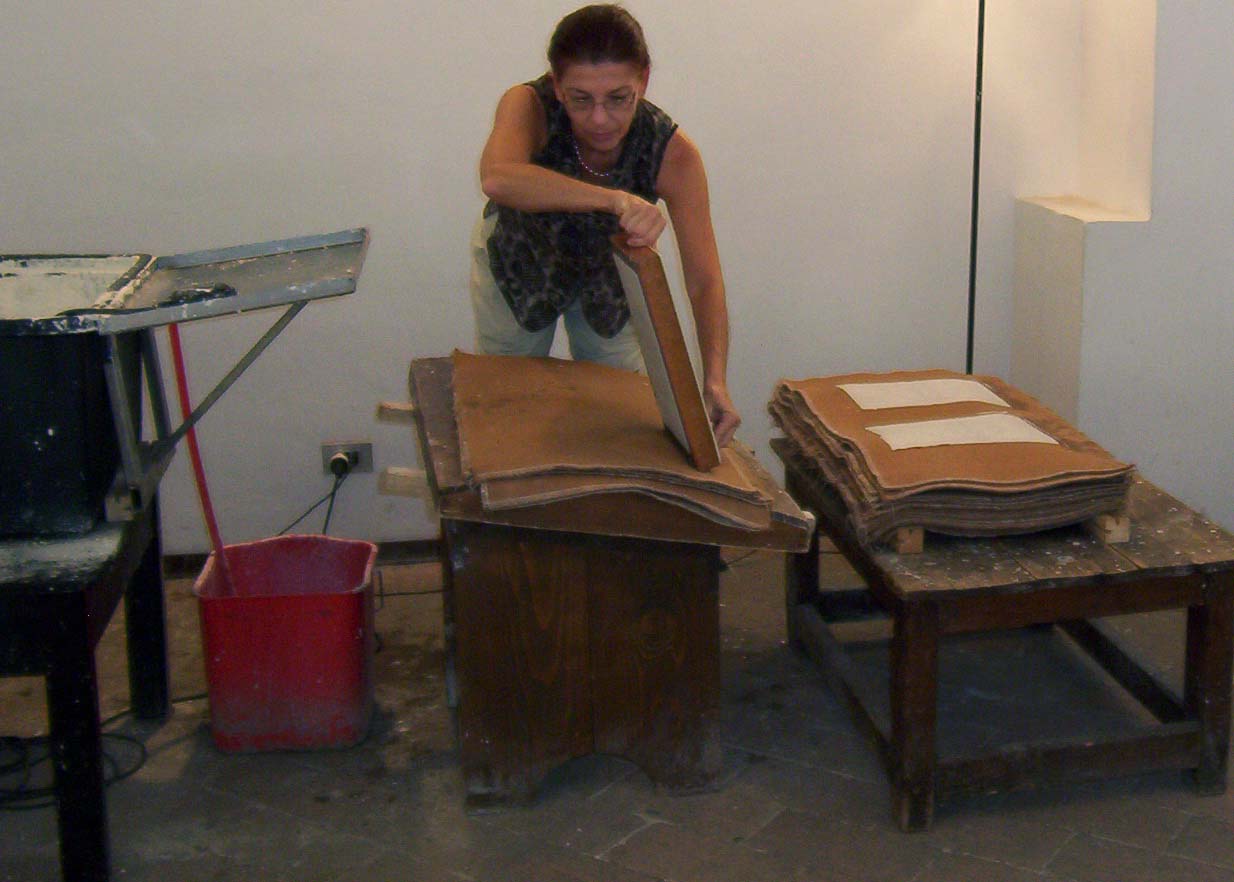
Kathy pulling paper at Museo della Carta in Fabriano, Italy.
Kathy "kooching," or pressing, the wet paper against a felt.